
12–18mo
Average Planning Timeline
Couples plan Hawaii destination weddings 12 to 18 months out — across mainland US, Japanese, Korean, and increasingly Southeast Asian source markets. The vendor that shows up correctly in their early research wins the booking.
We help Hawaii wedding venues, planners, photographers, florists, and officiants build digital pipelines that handle multi-source-market demand, DLNR permit questions, and the long planning funnel. Built on our local SEO and content strategy practices — part of our broader industries work and tied to tourism marketing.
12–18mo
Average Planning Timeline
May–Oct
Peak Hawaii Wedding Season
3+
Major Source Markets
Visual
Pinterest + Instagram First
//.unique_challenges
A Hawaii destination wedding is a once-in-a-lifetime, multi-thousand-dollar event coordinated remotely across language barriers and time zones. The marketing has to clear every objection before a couple ever calls.
Couples research destinations 12 to 18 months before booking. Your content has to capture both the early-research phase (“Hawaii vs Caribbean wedding”) and the late-decision phase (“Maui beach wedding venues with permits”).
Brides discover venues, photographers, and florists on Pinterest, Instagram, and increasingly through AI image search. Your visual asset SEO — alt text, image schema, file naming, EXIF retention — does more conversion work than your meta description.
Hawaii destination weddings come from mainland US, Japan, Korea, Australia, and increasingly mainland China. Multilingual landing pages and source-market-specific content are not optional for serious players in this space.
Beach weddings on state lands require Department of Land and Natural Resources (DLNR) permits. Resort weddings have venue rules. Officiants need state registration. Your content has to address these — couples search “do I need a permit for Maui beach wedding” before they search venue names.
A wedding is a once-in-a-lifetime, multi-thousand-dollar, in-person event coordinated remotely. Reviews, real-couple galleries, and detailed FAQ content matter more than for any other vertical. Content depth signals trustworthiness — thin sites lose to deep ones.
West Maui’s wedding industry was disproportionately impacted by the August 2023 wildfire. Marketing in Lahaina and surrounding communities requires sensitivity, accurate venue status communication, and community-aware messaging — not generic “paradise” copy.
//.our_services
Each venue, photographer, florist, planner, and officiant gets proper LocalBusiness schema, optimized Google Business Profile, and a deep services page. Built on our local SEO framework, tuned for the unusually long wedding research cycle.
Pinterest-friendly visual content, real-couple galleries with consent-cleared schema, planning timelines, and budget guides that earn educational searches and route to your booking funnel — built on our content strategy practice.
Japanese, Korean, and Chinese (simplified or traditional, depending on source market) landing pages for vendors targeting international destination weddings. Hreflang tags, market-specific copy, and locale-appropriate review surfacing.
Detailed guides on DLNR beach permits, county-by-county venue requirements, marriage license process, and common couple questions. These answer FAQ-style searches early in the funnel and route couples toward your services.
Photographer galleries, venue tours, and Instagram-cross-posted content optimized for image search and AI image-recommendation systems. ImageObject schema, descriptive alt text, and proper EXIF retention, set up for the places couples actually browse.
Inquiry forms, calendar integrations (HoneyBook, Dubsado, 17hats), and CRM connections that turn search traffic into qualified leads with full context — date, party size, budget tier — so you respond with the right pitch on the first reply.
//.hawaii_weddings
Hawaii’s destination wedding industry sits at the intersection of tourism economics, state-land permitting, and post-pandemic source-market shifts. Marketing here means staying current with the rules and the recovery.
Beach weddings on Hawaii state lands require Department of Land and Natural Resources (DLNR) permits with specific guest-count caps and time windows. County rules — Maui, Hawaii County, Kauai, Honolulu — layer additional venue-specific requirements. Couples expect this information upfront.
Japan was historically Hawaii’s largest destination wedding source market. Post-pandemic recovery has been gradual. Mainland US, Korea, and increasingly Southeast Asian source markets are growing. Your marketing mix has to reflect current source-market realities, not pre-2020 patterns.
The HWPA is the primary industry organization for Hawaii wedding vendors. Membership signals legitimacy to couples doing due diligence. Inclusion in HWPA member directories provides citation-quality backlinks and adds a layer of trust that paid directories cannot.
For the full deep-dive on Hawaii destination wedding market dynamics, DLNR permits, and source-market behavior, see our Hawaii Wedding Marketing Guide, plus our broader tourism marketing framework.
This page focuses on destination weddings — multilingual, permit-aware, visual-first marketing for the once-in-a-lifetime category. If you want the broader umbrella practice that covers hotels, tours, restaurants, and attractions as a connected ecosystem, see our tourism marketing playbook.
Tourism Marketingmultilingual · permit-aware · visual-first
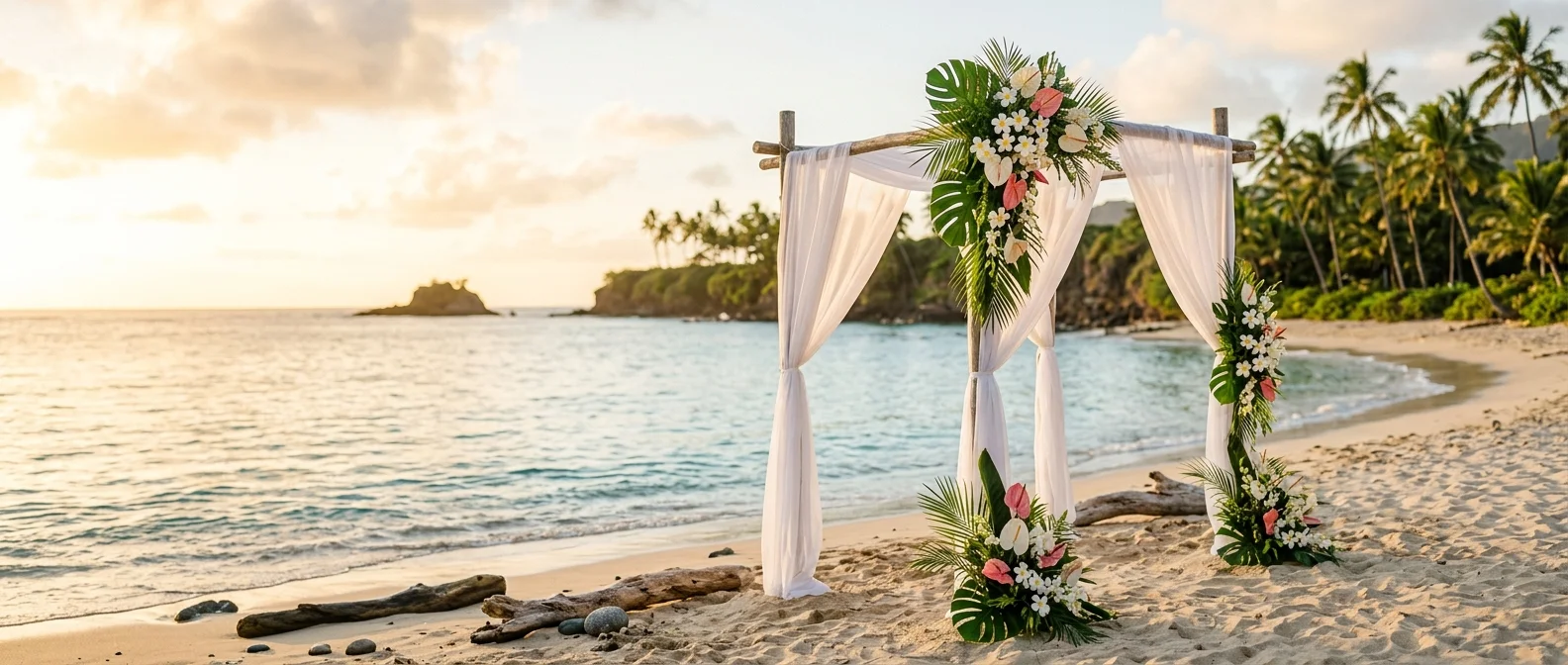
From beach-permit specialists to full-service planners — every wedding role has a different search rhythm.
Your marketing should match how couples actually search.
We serve:
Each vendor type has distinct booking funnels, source markets, and review dynamics.
Common questions from Hawaii destination wedding venues, planners, photographers, and vendors.
Couples planning Hawaii destination weddings typically start research 12–18 months before the date, often in their home market. We segment content by source market (Mainland US, Japan, Korea, Canada, Australia) and invest in multilingual landing pages where appropriate.
Yes — we can. The SEO foundation (hreflang, locale-specific landing pages, market-appropriate imagery and review surfacing) translates across languages. For Japanese or Korean copy specifically, we also partner with native-language writers and cultural reviewers so the result — including the handling of ceremony customs that differ across markets — reads naturally to the target audience rather than translated.
Yes — they have different buyer journeys, different review dynamics, and different visual-asset needs. Venues need property + capacity + permit content; planners need portfolio + process + testimonial depth; photographers need image-rich SEO and Instagram funnel work; vendors need niche-specific positioning. Each gets a tailored scope.
Hawaii beach-ceremony permits via DLNR (Division of State Parks) are a recurring source of confusion for mainland couples. We build educational content explaining the permit process, restricted beaches, fee structure, and timeline — content that converts qualified couples and screens out couples who’d be a bad fit. It also surfaces strongly in AI search when couples ask “can I get married on a Hawaii beach.”
Wedding queries are seasonal and high-intent. We start with your Google Business Profile in the first 30–60 days, build organic content and site improvements over 6–12 months, and plan around a full-year cycle so the work covers every wedding season. Twelve-month engagements are standard for venues; some planner and photographer engagements ship faster.
The broader practice that wedding work sits inside — Hawaii visitor-driven search behavior and source-market dynamics.
Google Business Profile, venue + vendor local indexing, and per-island search ranking.
Pillar guide on Hawaii destination wedding market dynamics, DLNR permits, and source-market behavior.
Multilingual content, planning-timeline guides, and permit explainers that capture early-research traffic.
Free wedding marketing audit — we will analyze your visual asset SEO, multilingual reach, permit-content depth, and Pinterest / Instagram visibility.