
Digital Marketing for Schools. Built for Hawaii's Classrooms.
A parent's first impression of your school is no longer the front office — it is your website, your Google reviews, and the answer ChatGPT gives when they ask for the best school in your town.
We help Hawaii's public, charter, and private schools fill seats with accessible websites, enrollment-focused SEO, and visibility inside AI search. As a registered State of Hawaii vendor, we can be procured and paid by public schools — and we work fast for private schools that move on a handshake. This is part of our industries practice, built on local SEO and accessible web design.
165,340
Hawaii Public + Charter Students
19%
Attend Private School (Highest in US)
Apr 2027
ADA Title II WCAG 2.1 AA Deadline
45%
Now Use AI for Local Recommendations
Why Marketing a School
Is Its Own Discipline.
Marketing a Hawaii school is shaped by a single statewide district, public procurement law, accessibility deadlines, student-privacy rules, and a multilingual community. Generic agency playbooks miss all five.
One District, Three Buyers
Hawaii runs the only statewide single school district in the country. Public schools buy one way, the 38 independent charter schools another, and private schools a third. A page that treats them the same speaks to none of them.
Public Procurement Law
Spending public money means Chapter 103D — quotes, RFPs, vendor compliance, and HIePRO. Most agencies have never registered as a state vendor, so a public school literally cannot pay them. We have.
A Hard Accessibility Deadline
The 2024 ADA Title II rule requires public-school websites to meet WCAG 2.1 Level AA, with a compliance date of April 26, 2027 for larger entities. A school site that fails accessibility is now a legal exposure, not just a design flaw.
Student Privacy (FERPA)
FERPA limits how any vendor touches student data — and bars using it for advertising. Retargeting and ad-tech that mainstream agencies deploy by default can put a school out of compliance. Our workflows are built around the school-official rule.
A Multilingual Community
Up to 14% of Hawaii public-school students are English Learners, with Ilokano, Chuukese, Marshallese, Tagalog, and Spanish among 70-plus home languages. Reaching families means translated, accessible communication — not an afterthought widget.
Parents Ask AI First
"Best private school in Honolulu?" is now a question for ChatGPT and Google AI Overviews as often as a search. Answer engine optimization decides whether the AI names your school — or a competitor's.
Two Buyers, Two Playbooks
A district office and a private-school head of school are solving different problems on different timelines. We run a distinct motion for each — and the page below is organized so you can jump to yours.
//.public_and_charter
Public & Charter — Institutional
The work is accessible, compliant, and procurable: WCAG 2.1 AA websites, FERPA-aware analytics, and clear enrollment and boundary communication — delivered through a process your business office already understands.
Bought through Chapter 103D quotes and RFPs. Calendar-driven. Won on the proposal, not the lunch.
//.private_enrollment
Private — Enrollment
The work is conversion: admissions funnels, open-house registration, brand and differentiation, AI-answer visibility, and reputation — built to grow applications and justify tuition in the most private-school-heavy market in the country.
Bought on a relationship, fast. No procurement code, no public posting — a signed agreement and we start.
How We Help Hawaii Schools Grow
Enrollment & Admissions Marketing
Admissions-funnel landing pages, open-house and tour registration, and follow-up that turns interest into applications. Built for the most competitive enrollment market in the country, where 19% of students already attend private school and the student pool is shrinking.
Accessible, WCAG 2.1 AA Websites
Fast, mobile-first school websites built to WCAG 2.1 Level AA — the ADA Title II standard for public schools — with a VPAT conformance report included. Accessibility is a legal requirement and a ranking signal; we treat it as both. Built on our web design practice.
AI-Search Visibility (AEO + GEO)
Helping your school compete to be the one ChatGPT, Perplexity, Gemini, and Google AI Overviews name — and describe correctly — when a parent asks. We engineer the structured data and answer-shaped content that make a school citable — our answer engine optimization and generative engine optimization practices, applied to enrollment.
Multilingual Reach
Translated enrollment materials and accessible parent communication for Hawaii's English-Learner families — Ilokano, Chuukese, Marshallese, Tagalog, and Spanish among them. Reaching every family in your boundary is both an equity obligation and an enrollment opportunity.
Reputation, Reviews & Google Business Profile
Accurate listings, managed reviews, and a complete Google Business Profile across the directories AI engines read — Google, Niche, GreatSchools, Private School Review. The off-site trust signals that decide which school the AI recommends, built on our local SEO framework.
Program Promotion & Findability
Make your distinctive programs discoverable — Hawaiian-language immersion, STEM, IB, arts, athletics, place-based learning. Immersion enrollment alone has grown 68% in a decade; demand exists, but only if families can find the program when they search.
How Public Schools Can Actually Hire Us
Most marketing agencies cannot take a dollar of public-school money — they were never set up to. Nekko Digital is a registered State of Hawaii vendor, which means a HIDOE school, complex office, or charter can procure and pay us through the channels your business office already runs.
Public spending runs through the Hawaii Procurement Code (Chapter 103D). Most marketing engagements fall under small-purchase rules below $100,000 — frequently three quotes through HIePRO — while larger scopes run as a Request for Proposals. Here is the path, end to end:

Issuing a quote request or an RFP? We respond to both. Tell us what you need and we will return everything your procurement file requires.
Compliance Is the Product, Not a Disclaimer
Three bodies of law shape what a Hawaii school's marketing can and cannot do — web accessibility, student-records privacy, and children's online privacy. We treat each as a build requirement, not a footnote. (Nothing here is legal advice; confirm specifics with your district's counsel or privacy officer.)
ADA Title II & WCAG 2.1 AA
The U.S. Department of Justice's 2024 ADA Title II rule requires public schools' web content and mobile apps to conform to WCAG 2.1 Level AA (ADA.gov). DOJ extended the deadlines in April 2026, so the current compliance dates are April 26, 2027 for entities serving 50,000 or more people — which HIDOE does statewide — and April 26, 2028 for smaller entities and special districts. WCAG 2.1 AA is concrete: sufficient color contrast, text alternatives for images, full keyboard operability, captions, clearly labeled forms, and content that survives assistive technology — the exact failures 95.9% of the web's top home pages still trip (WebAIM Million, 2026). We build to it and document conformance with a VPAT.
FERPA — Student Data Stays the School's
FERPA protects student education records and bars using them for advertising. Two rules shape marketing: a vendor may touch student data only under the school-official exception — under the school's direct control, for a legitimate educational interest, never reused — through a signed data agreement (the same vendor-data discipline a clinic applies with a HIPAA business associate agreement); and "directory information" such as a student's name or photo may be used only after annual notice and a parent opt-out window. Our default removes the question: marketing and analytics that collect no student personally identifiable information, and no retargeting or ad-tech on student-facing pages.
COPPA — When a Site Reaches Under-13s
If a school site — or an edtech tool it embeds — is directed to children under 13 or knowingly collects their data, COPPA requires verifiable parental consent before collection. The FTC's amended COPPA Rule (effective June 23, 2025; compliance by April 22, 2026) now also requires separate parental consent before a child's data is shared with third parties — which directly constrains the analytics tags, embedded widgets, and ad pixels on pages young students actually use. We keep children's-facing pages free of third-party data collection by default.
The Page You Are Reading
A vendor that sells accessible websites should ship one. This page is built to the same WCAG 2.1 AA standard we deliver — semantic structure, real contrast, keyboard-navigable, described images. (Section 508 is the parallel federal standard; for Hawaii public schools the governing law is ADA Title II.)
Compliant vs non-compliant, in practice
| What to avoid | What works instead | Why |
|---|---|---|
| Retargeting pixels or ad-tech on student-facing or under-13 pages | Marketing pixels only on public, adult-facing admissions pages; none on student-facing pages | FERPA bars advertising use of student data; COPPA requires verifiable parental consent for under-13 data. |
| Collecting student names or details through an inquiry form into a non-agreement CRM | Forms that collect parent/guardian contact only, into a vendor under a signed data agreement | Student PII in a vendor system without a school-official data agreement breaches FERPA. |
| Publishing student names or photos with no media release on file | Media-release-cleared images only; treat names and photos as directory info with an opt-out on file | Directory information may be disclosed only after annual notice and a parent opt-out window. |
| An enrollment site that fails contrast, keyboard navigation, or image alt text | A WCAG 2.1 AA build with a VPAT conformance report | ADA Title II makes inaccessible public-school web content a legal exposure, not just a UX flaw. |
The AI Decides
the Shortlist Now.
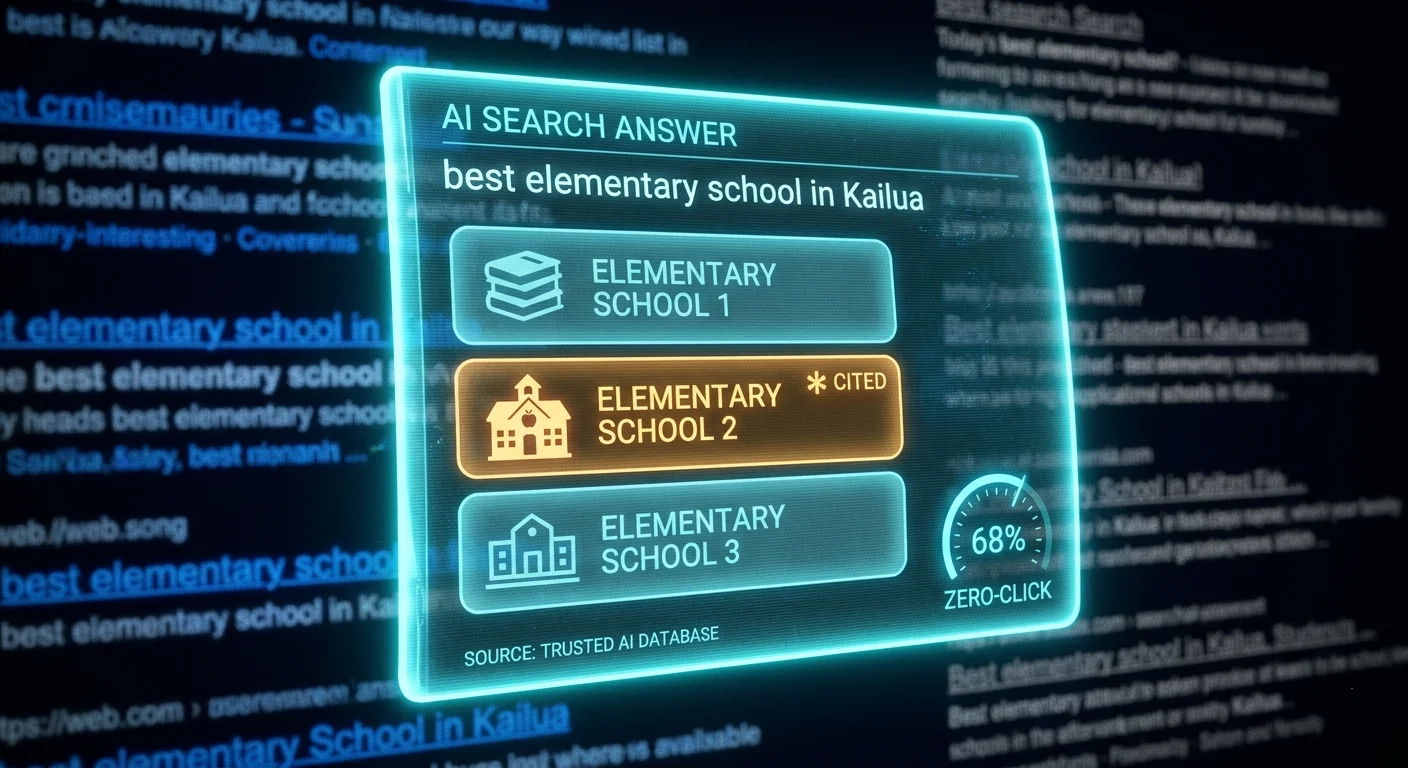
A beautiful website can still be invisible in the answer a parent actually reads. The research moment for "best school near me" has moved from a list of links to a single AI-generated recommendation — and a school that is not named is not considered.
2B
monthly users on Google AI Overviews as of Q2 2025 — the AI answer now sits atop the search parents already use.
900M
weekly ChatGPT users by early 2026 — the standalone tool parents type school questions into.
~68%
of US Google searches ended without a click in 2026; AI Overviews cut click-through by nearly 60% when present.
63%
of AI users trust the recommendations AI tools give them — the narrative the AI tells carries real weight.
We measure this directly. Our Reef Citation Index™ and Hawaii AI Search Visibility Index track how often AI assistants cite Hawaii institutions, so we can see whether a school is in the answer and what to work on if it is not. The published 2026 benchmark measured Anthropic Claude; we run the same method on ChatGPT, Perplexity, or Gemini on request.
The Reef Method, Applied to a School
Four layers an AI engine needs before it will name and recommend your school to a searching family — accurate, authoritative, cited, and trusted.
Visibility that fills classrooms.
Proof, Not Promises
We are a new entrant in the education vertical, and we will not invent a school client we do not have. What we bring instead is our own published, Hawaii-specific measurement of AI-search visibility in the state: the Hawaii AI Search Visibility Index and the Reef Citation Index™, both released under an open license.
That research is the engine behind this service — the same methodology that measures how Hawaii businesses surface in AI answers measures, and improves, how a Hawaii school does. When a school client's results exist, they will be published here with the same transparency.
Schools We Work With
From a single charter campus to a multi-school private system — every format recruits differently.
Your marketing should match how families find you.
We serve:
- HIDOE Public Schools
- Complex Areas & Offices
- Public Charter Schools
- Private & Independent (PK-12)
- Faith-Based Schools
- Hawaiian-Focused & Immersion
- Montessori & Waldorf
- Special-Purpose Schools
- Preschools & Early Learning
- Boarding & Day Schools
- STEM & Arts Academies
- Microschools & Learning Pods
Each format has its own enrollment, compliance, and procurement reality.
Frequently Asked Questions
Procurement and marketing questions from Hawaii's public, charter, and private schools.
Is Nekko Digital a registered State of Hawaii vendor? +
Yes. Nekko Digital is a registered State of Hawaii vendor. That means a public school, complex office, or HIDOE program can procure and pay us for marketing and web services through the state's normal channels — including a Hawaii Compliance Express Certificate of Vendor Compliance, the clearance required for any award or payment of $2,500 or more.
How does a Hawaii public school actually procure us? +
Public schools buy under the Hawaii Procurement Code (Chapter 103D). Most marketing engagements fall under small-purchase rules below $100,000 — often three quotes through HIePRO, the state eProcurement system — while larger scopes run as a Request for Proposals. We respond to quotes and RFPs and invoice once a contract is awarded. The exact method is set by the agency and dollar amount.
Do your school websites meet ADA and WCAG accessibility requirements? +
Yes. We build to WCAG 2.1 Level AA — the standard the U.S. Department of Justice's 2024 ADA Title II rule sets for public schools' web content, with a compliance deadline of April 26, 2027 for larger government entities. We provide a VPAT / accessibility conformance report so your district has documentation, not just a promise.
How do you handle student data and FERPA? +
We design marketing and analytics so they do not collect student personally identifiable information. Where any student data is involved, we work under a signed data agreement and FERPA's school-official rules — meaning student data stays under the school's control and is never used for advertising or any secondary purpose.
What does enrollment marketing for a private or charter school include? +
Admissions-funnel landing pages, open-house and tour registration, search and AI-answer visibility for queries like "best elementary school in Kailua," multilingual content, reputation and Google Business Profile management, and program promotion. Private schools can engage fast on a relationship basis; charters get lottery-application awareness built around their mission.
Why does AI search matter for a school? +
Parents increasingly ask ChatGPT, Perplexity, and Google AI Overviews which school to choose — then read the AI's answer instead of clicking. In 2026, 45% of consumers use AI to find local recommendations (BrightLocal) and roughly 68% of Google searches end without a click (SparkToro). If the AI does not name your school, you are absent from the shortlist.
Do you market to Hawaii's multilingual families? +
Yes. Up to 14% of Hawaii public-school students are English Learners — speaking Ilokano, Chuukese, Marshallese, Tagalog, and Spanish among more than 70 home languages (HIDOE). We build translated enrollment content and accessible parent communication so your message actually reaches the families in your boundary or target market.
What happens in the first months of working together? +
In the first 30–60 days we handle technical fixes, accessibility work, and Google Business Profile improvements. After that, we build content for competitive enrollment queries and AI answers, month by month. We report monthly with visibility and inquiry metrics so the trajectory is visible the whole way.
Does COPPA apply to our school's website? +
It can. If your site — or an embedded edtech tool — is directed to children under 13 or knowingly collects their data, COPPA requires verifiable parental consent before any collection. The FTC's amended COPPA Rule (effective June 23, 2025, with compliance by April 22, 2026) also requires separate parental consent before a child's data is shared with third parties, which constrains analytics and ad pixels on pages young students use. Our default keeps children's-facing pages free of third-party data collection, so the question rarely arises.
Related Resources.
Hawaii Education Marketing Guide
The full playbook — ADA Title II accessibility, FERPA and COPPA, the enrollment funnel, AI school-choice search, and state procurement.
OpenReady to Fill More Seats?
Free school marketing audit — we will analyze your website's accessibility, your enrollment search visibility, and whether AI engines name your school. Issuing an RFP? We are a registered State of Hawaii vendor and respond to quotes and proposals.