
Hawaii Brands. Mainland Expansion. A practical playbook.
Going mainland is no longer ambition for a Hawaii brand — for many it is survival math. Hawaii's resident population has been shrinking ~0.3%/yr since 2020, and net out-migration runs eleven people per day.
This playbook documents how Hawaii-grown brands actually expand: the case examples that worked (Maui Jim's Kering exit, Hawaiian Host's $26M repatriation, Kona Brewing's split-brand path), the channels they used (Whole Foods Local Forager, Costco Roadshows, Hawaiian Airlines Pau Hana Cart, Mana Up), the trust-mark and authenticity rules, and the failure patterns to avoid. Every figure cites a public source.
Last updated: 2026-05-08.
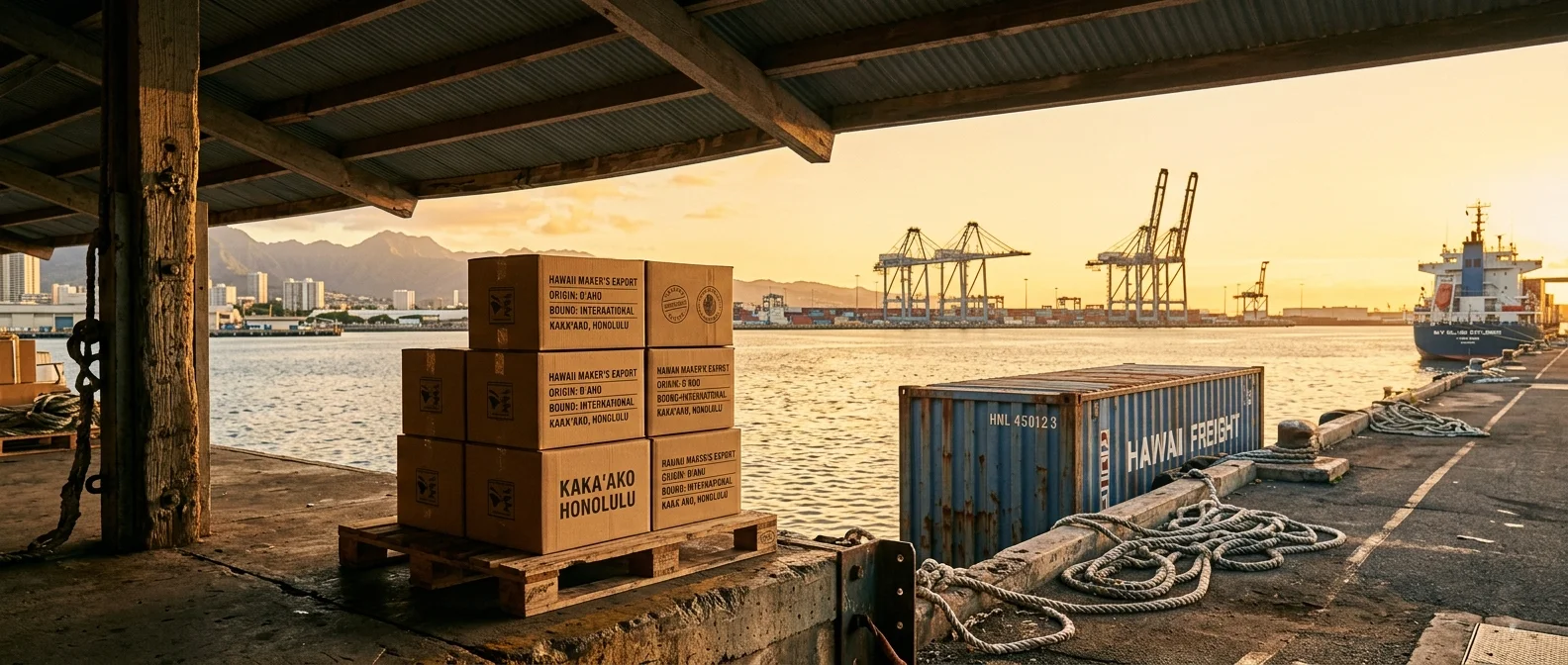
Why Mainland Expansion Is Not Optional.
Hawaii's resident population is 1,432,820 (2025), declining roughly 0.3% per year since 2020 — net out-migration of ~11/day vs. +6/day natural increase. Per Hawaii DBEDT 2025 estimates. The local total addressable market is small, getting smaller, and visitor spend — while strong — is concentrated in hospitality and retail.
For a Hawaii brand at $1M ARR, mainland expansion is the only realistic path to $5M and beyond. The good news: there's a real authenticity premium for genuine Hawaii origin, and a set of specific channels — most of them under-used — that work.
Case Examples — Brands That Went Mainland
Five Hawaii-grown brands whose mainland trajectories tell five different stories. Founded years, exits, ownership changes, and channel choices are public — sources linked.
Hawaiian Host — the round-trip story
Founded 1927 as Ellen Dye Candies in Honolulu; renamed Hawaiian Host in 1960 by Mamoru and Aiko Takitani. Expanded to mainland US, Japan, and Singapore through wholesale and airport/duty-free retail. Acquired Mauna Loa from Hershey in 2015. April 2023: invested $26M to acquire MacFarms, Royal Hawaiian Orchards, and Kapua Orchards — explicitly framed as bringing macadamia stewardship "back to Hawaiʻi."
Sources: Hawaiian Host Group (Wikipedia) · HHG newsroom 2023.
Maui Jim — Lahaina beach hustle to luxury exit
Started 1980 as a beach-vendor sunglasses business in Lahaina. Captain Walter Hester bought it in 1991; merged with RLI Vision in 1996, HQ moved to Peoria, IL. By 2015, world's #3 sunglass maker. October 2022: Kering Eyewear completed acquisition — "once in a lifetime opportunity." Forty-two years from beach to luxury conglomerate.
Sources: Maui Jim (Wikipedia) · Kering Eyewear announcement.
Kona Brewing — when scale split the brand
Founded 1994. Craft Brew Alliance (CBA) bought Kona for $18M in 2010 with AB InBev simultaneously taking 32.2% of CBA. AB InBev acquired the rest of CBA in 2019. September 2020: DOJ antitrust action forced spin-off of Kona's Hawaii operations to PV Brewing Partners ($16M). Mainland Kona brand sits inside AB InBev today; Hawaii Kona is independent.
Sources: Kona Brewing (Wikipedia) · Food Dive · Star-Advertiser 2020.
ALOHA — the "Hawaiian-inspired but not HQ'd" path
Founded 2013 with Hawaiian co-founders; "refounded" 2017 under CEO Brad Charron. Manufactures in NY (drinks), Colorado (bars), Georgia (powders) — Hawaiian ingredients sourced separately for SKUs like the Kona bar. Raised $68M from SEMCAP in 2024. Cleanest example that scale often comes by ceding HQ presence on the islands.
Sources: Foundr — Brad Charron · Food Dive 2024.
Honolulu Cookie Company — the airport-channel strategy
First mainland store: Las Vegas (Palazzo / Grand Canal Shoppes), 2014. ~14 retail locations total; mainland footprint remains essentially the single Vegas store. Founder Keith Sung confirms airport (DFS / iShoppes) is strategically more important for mainland-bound visitor sales than direct mainland retail — visitors carry the brand home to all 50 states.
Sources: Honolulu Cookie (Wikipedia) · Star-Advertiser, April 2026.
The Strategic Realities of Expanding from Hawaii
Five constraints (and one structural advantage) every Hawaii brand owner has to plan around.
The shipping duopoly
Matson and Pasha are the only scheduled ocean carriers between Hawaii and the mainland — a Jones-Act-protected duopoly. A 2020 Grassroot Institute study estimated the Jones Act costs Hawaii ~$1.2B/yr (~$1,800/family). Container rates are not publicly published; third-party forwarders quote ~$5,000–$16,000 per FCL container for general commodity. Forwarder estimate, not Matson/Pasha rate-card data: Approved Forwarders.
The GET cascade
Hawaii's General Excise Tax (4% state + up to 0.5% county = 4.5%) applies at every B2B step, not just retail — a structural cost-stack disadvantage versus mainland competitors who only see sales tax at point of sale. Source: Hawaii Department of Taxation.
Limited local TAM
Hawaii's resident population: 1,432,820 in 2025, declining ~0.3%/yr 2020–2025 (DBEDT 2025 estimates). Most consumer brands hit the local market ceiling within 3–5 years of strong growth. Mainland is the only realistic next chapter.
The authenticity premium — and the counterfeit risk
Genuine Hawaii origin commands premium retail pricing on mainland — but Hawaii product designations (especially Kona coffee) are among the most counterfeited in the world. October 2025: federal indictment of a 66-year-old Kona woman accused of selling $5.2M+ of fake "100% Kona" coffee (2012–2024). Civil class action: $21M+ in farmer relief. Industry asymmetry: only ~2.7M lbs of authentic Kona green is grown annually, but more than 20M lbs labeled "Kona" sells at retail. Sources: Hawaii News Now · Lieff Cabraser — Kona coffee class-action final settlement.
The trust-mark asset: "Made in Hawaii with Aloha"
The official Hawaii origin trust mark is "Made in Hawaii with Aloha" (MIHA) — a certification trademark administered by the Hawaii Department of Agriculture & Biosecurity, governed by HRS §486-119. Application requires a formula worksheet review. Source: HDOA Made in Hawaii with Aloha program. For brands defending the authenticity premium against counterfeiters, MIHA certification is a legal asset, not just marketing.
The macro tailwind: "Hawaii as Terroir"
The Specialty Food Association's 2025 Trendspotter Panel named "Hawaii as Terroir" a top US food trend. The 2026 Winter FancyFaire (San Diego, January) hosted 12+ Hawaii makers via the DBEDT/Hawaii Made Pavilion (Aloha State Daily). The macro tailwind is real and named.
 //.tactics
 Channels That Actually Work
Five concrete channels — verified entry programs, real producer counts, dollar amounts where public.
Whole Foods Market — Local Forager program
"Local" = within state or 275 miles of store. Whole Foods Hawaii works with 280+ local producers, sources 43% of produce sold in HI from HI-grown sources, and purchases more than $4M/yr from HI farms, ranches, and dairies. The Local + Emerging accelerator offers 6 months education + 1 year mentorship for early-stage HI brands. Sources: Whole Foods Market — Hawaii vendor facts · Grocery Dive.
Costco Roadshows
Hawaii local SKUs already at Costco HI include Hawaiʻi Harvest, Hamakua Mushrooms, Mahi Pono, Kawamata Farms, Sugarland, and Taro Brand. There is no formal "HI-brands-debut-on-mainland-via-Roadshow" program — brands self-book Roadshows via Costco buyers. Source: Mojo Sales & Branding.
Hawaiian Airlines Pau Hana Cart + Mana Up partnership
Active partnership since 2018. Featured brands include Kunoa Cattle Co. beef bar (all U.S. Mainland + select international flights), Kō Hana Rum, NOHO Home, the Leihōkū Collection. February 2025: 9-company collaborative collection launched. This is the closest thing to a HI-only launchpad that scales nationally without mainland retail leases — visitors carry product home to every metro. Sources: Alaska Air newsroom (post-2024 Hawaiian acquisition) · Mana Up.
Mana Up — accelerator + venture capital
105 portfolio companies as of 2025. Cohort 10 announced 2025. $6.3M venture fund. Notable alumni: Kō Hana Rum, Big Island Coffee Roasters, Manoa Chocolate, Banan, Coco Moon, Mohala Eyewear, NOHO Home. The single most important community for HI-brand mentorship + capital + Hawaiian Airlines retail exposure. Source: Mana Up Cohort 10.
Specialty Food Association — Fancy Food Show / Winter FancyFaire
The trade show where mainland buyers actually meet HI brands. 2025 Trendspotter Panel named "Hawaii as Terroir" a top US trend (PR Newswire / SFA). 2026 Winter FancyFaire (San Diego, Jan 11–13): 12+ Hawaii makers via DBEDT / Hawaii Made Pavilion — Aloha Bites, Da Kine Hawaiian, Hawaii ʻUlu Cooperative, Hawaiian Krunch, Hawaiian Soda Co., Island Rayne, Kuleana Rum, Maui Fruit Jewels, Noh Foods. Source: Aloha State Daily.
The State Export Program (HiSTEP)
Hawaii's state-level export-acceleration program is funded by SBA and run through DBEDT. It works — and the dollar-quantified outcomes are public.
HiSTEP — lifetime impact
- 1,600+ companies assisted
- ~$258 million total economic impact
- 1,400 jobs supported
- ~$13 million/yr new export sales
- ~$10.8 million/yr in state taxes generated
SBA awarded DBEDT $525,000 in September 2024 to continue HiSTEP. Source: DBEDT release 24-51.
For context: 86.6% of Hawaii's 677 identified exporters in 2022 were small businesses, accounting for $194.0M of $341.0M total identified exports (56.9%). Source: SBA Hawaii Profile 2025. Most Hawaii brands pursuing mainland scale qualify for HiSTEP support.
Failure Patterns to Avoid
Going too big on retail too soon
Brands that secure a national retail rollout before they have the supply chain to support it routinely fail at restocks. Whole Foods Local Forager and Costco Roadshows are intentionally "trial" channels. Use them to learn before committing to broad distribution.
Ceding HQ before earning the premium
OluKai (Orange County) and ALOHA (NY/CO/GA) demonstrate the "Hawaiian-inspired but not HQ'd" path — strategically valid for scale, but it cedes the authenticity premium that small operators can defend. Move HQ after the premium is established, not before.
Counterfeits + IP unaddressed
If your category has a counterfeit problem (Kona coffee, Hawaiian sea salt, lei products), enforcement is part of brand strategy. Trademark registration, MIHA certification, and origin-verification programs are not optional — they are the legal moat that lets the authenticity premium survive.
Brand-narrative dilution
Kona Brewing's split-brand outcome — mainland Kona (AB InBev) and Hawaii Kona (PV Brewing) now tell different stories — is a cautionary tale about scaling faster than the brand identity can absorb. Plan the narrative architecture before the exit conversation, not after.
Related Resources.
National SEO
When you're ready to engage on the SEO and AI-search work that supports mainland scale.
OpenReady to Take Your Brand Mainland?
We work with Hawaii brands on the digital infrastructure of mainland expansion — DTC, search, AI citation, and channel-partner content. Start the conversation.