
By Rodrigo Diniz · Last updated: May 2026
Wedding Marketing in Hawaii: The 2026 Definitive Guide
A Hawaii destination wedding is a once-in-a-lifetime, multi-thousand-dollar event coordinated remotely across language barriers and time zones — typically planned 12 to 18 months in advance, sourced from mainland US, Japan, Korea, and increasingly Southeast Asian markets. The marketing playbook for this vertical does not look like the playbook for a hotel or a restaurant. This pillar is the working playbook for Hawaii wedding venues, planners, photographers, florists, officiants, and the broader vendor ecosystem.
This guide pairs with our wedding marketing industry page and lives inside our broader industries work. References cite publicly available DLNR permit guidance, HTA visitor segmentation, HVCB MCI program documentation, and Hawaii Wedding Professionals Association sources where applicable. Specific dollar-figure citations are intentionally conservative; the destination wedding market has wide reported ranges depending on source methodology.
1. Hawaii's Wedding Market: What We Can and Can't Cite
The Hawaii destination wedding market is significant, multi-island, multi-language, and not particularly well-quantified by any single authoritative source. Here is what we can cite confidently, and where we have to qualify.
What is well-documented
- Hawaii receives roughly 9.6 million annual visitors (HTA), and a substantial share are couples celebrating weddings, anniversaries, honeymoons, or vow renewals. The destination wedding segment sits inside HTA's broader visitor data and inside HVCB's Meetings, Conventions, and Incentives (MCI) program.
- Hawaii Department of Health (DOH) issues marriage licenses and publishes annual issuance counts. The split between resident and non-resident license issuance is one of the more reliable proxies for destination wedding volume.
- The Knot publishes an annual Real Weddings Study with destination-specific cost and behavior data; Hawaii is consistently among the most expensive destination wedding markets in the United States.
- The Hawaii Wedding Professionals Association (HWPA) is the primary trade association for Hawaii wedding vendors. Membership signals legitimacy and provides citation-quality directory presence.
- The August 2023 Lahaina wildfire materially impacted West Maui's wedding industry — venues, vendors, and the region's broader marketability all changed. Marketing in Lahaina and West Maui requires sensitivity to that ongoing reality.
What we have to qualify
Aggregate dollar figures for the Hawaii destination wedding industry vary widely by source — figures in the $300–500M annual range are commonly quoted but the underlying methodologies are inconsistent. Source-market mix has shifted materially post-pandemic, with Japan recovering more slowly than initially projected and Korea growing faster. Specific vendor-segment volumes (planners vs venues vs photographers) are not centrally reported. Where this guide cites a number, the source is named; where the number is uncertain, the language reflects that.
What this means for marketing
The data thinness is itself a strategic signal. Wedding vendors with their own well-instrumented owned-channel analytics — booking source data, inquiry-to-booking conversion by source market, package-tier mix — are operating with a clearer picture than the aggregate market provides. Owned data is the basis for most strategic decisions, including the localization questions covered in Section 7.
2. How Do Hawaii Wedding Couples Actually Search?
Wedding research is the longest planning funnel of any consumer purchase outside real estate. Couples typically begin researching destinations 12 to 18 months before the wedding date, with luxury and large-party weddings stretching to 24 months. The platforms used at each phase are distinct — and the platforms shift across phases more than they would for any other purchase.
The four-phase wedding planning funnel
- Destination decision (12–24 months out). Pinterest, Instagram, AI assistants ("best places for a destination wedding"), travel and bridal blogs. Visual-first; image SEO and AI image search increasingly drive shortlist creation.
- Venue + planner shortlist (9–12 months out). The Knot, WeddingWire, Zola Weddings, Junebug Weddings, Style Me Pretty, and direct vendor websites. Reviews, real-couple galleries, and detailed FAQ content drive shortlist narrowing.
- Vendor selection (6–9 months out). Photographer galleries, videographer reels, florist portfolios, officiant bios. Visual portfolio quality is the dominant decision factor.
- Logistics + final coordination (0–6 months out). Permit information, marriage license process, vendor coordination, accommodations for guests. FAQ-style content earns this traffic.
Pinterest as a uniquely important channel
Pinterest functions as a long-window inspiration board for wedding planning unlike any other vertical. Couples save Hawaii wedding venue images months or years before they engage vendors directly, and the same pin can drive traffic two years after publication. Pinterest SEO — descriptive pin text, vertical aspect ratios, board organization, and rich pin schema — has unusual long-term ROI for wedding vendors.
AI itinerary planning
A growing share of couples now ask AI assistants to help plan their destination wedding: "plan a 5-day Hawaii wedding for 50 guests on Maui," "best photographers in Wailea." AI engines route these queries to vendors with strong E-E-A-T signals, structured data, and authoritative on-site content. The vendors cited in those itineraries earn brand equity and direct intent — even when the AI does not embed a click-through.
3. The Multi-Source-Market Reality
Hawaii destination weddings are sourced from four to five major markets, each with distinct booking behaviors, language requirements, and platform mixes. Vendors who serve only the mainland US market with English-only content forfeit demand to competitors who localize.
Mainland US
The largest source market by volume. English-language site, mainstream wedding directories (The Knot, WeddingWire, Zola), Pinterest- and Instagram-heavy discovery. Mainland US couples typically plan 12–18 months out and research extensively before vendor outreach. The default optimization target.
Japan
Historically Hawaii's largest international destination wedding source market, with notable post-pandemic recovery still underway. Japanese couples reach Hawaii through different channels: traditional travel agencies (JTB-affiliated wedding programs), Japanese-language wedding magazines and directories, and Rakuten Travel's wedding-adjacent inventory. A Japanese-language landing page with hreflang ja-JP, accurate Japanese translation of vendor and venue copy, and culturally appropriate visual aesthetics is the highest-leverage international localization for most established Hawaii vendors.
Korea
Growing destination wedding source market. Korean couples research through Naver (not Google) and KakaoTalk-adjacent travel platforms. Korean-language landing pages with proper hreflang ko-KR are typically the second-priority international localization, with the lift increasing as Korean-source bookings approach 10% of vendor volume.
Australia + New Zealand
Counter-seasonal demand — their summer is Hawaii's winter — making this segment particularly valuable for vendors looking to balance peak-season concentration. English-language, smaller volume, but customers who arrive consistently in shoulder season.
Mainland China + Southeast Asia
Variable year-to-year; pre-pandemic Chinese demand was significant, post-pandemic recovery has been uneven. Singapore and select Southeast Asian markets are growing for luxury destination weddings. For vendors with confirmed bookings from these markets, simplified Chinese landing pages and engagement with relevant regional travel agencies pay off — but the cost-benefit math is less favorable than for the Japanese and Korean localizations above.
4. What Are the DLNR Permit and County Venue Rules?
Hawaii's wedding permit and venue rules are the regulatory layer that catches couples and vendors off guard most often. Surfacing this information clearly is both a service to your couples and a SEO play — couples search permit-related queries early and often during planning.
DLNR commercial use permits
Weddings on Hawaii state beach lands — administered by the Department of Land and Natural Resources (DLNR) — require commercial use permits with specific guest-count caps (commonly 100 attendees or fewer for standard permits) and time-window rules. Permit applications are submitted in advance with associated fees. The exact requirements vary by location and updated rule sets; vendors should reference current DLNR guidance directly when working with couples on beach venues.
County venue rules
Each Hawaii county — Maui County, Hawaii County (Big Island), Kauai County, and the City and County of Honolulu — layers its own venue rules on top of state requirements. Sound ordinance limits, parking requirements, and special-use permits vary materially. Maui County in particular tightened a number of permit categories following the 2023 Lahaina wildfire. Vendors operating across multiple islands need permit content that addresses each county distinctly.
Marriage license process
Hawaii's marriage license is issued by the Hawaii Department of Health (DOH) under §572 HRS. Couples can apply online and receive the license at any DOH agent location statewide; the license is valid for 30 days from issuance and can be used at any wedding location in the state. Officiants must be registered with DOH prior to performing the ceremony. Surfacing this process clearly on a vendor site removes a meaningful source of out-of-state couple anxiety.
Why permit content earns SEO
Couples search for permit information well before they search for venue names. "Do I need a permit for a Maui beach wedding," "how to get a Hawaii marriage license," "beach wedding rules Kauai" — these queries have meaningful volume and are typically poorly served by generic wedding-blog content. Vendors with detailed, accurate, regularly updated permit content earn this early-funnel traffic and position themselves as the credible local expert before the venue conversation begins.
5. Visual-First SEO
Wedding planning is the most visual-first vertical we work in. Couples shortlist venues, photographers, and florists from images and reels — not from text. Visual asset SEO does more conversion work than meta descriptions on most wedding vendor sites.
Image SEO fundamentals
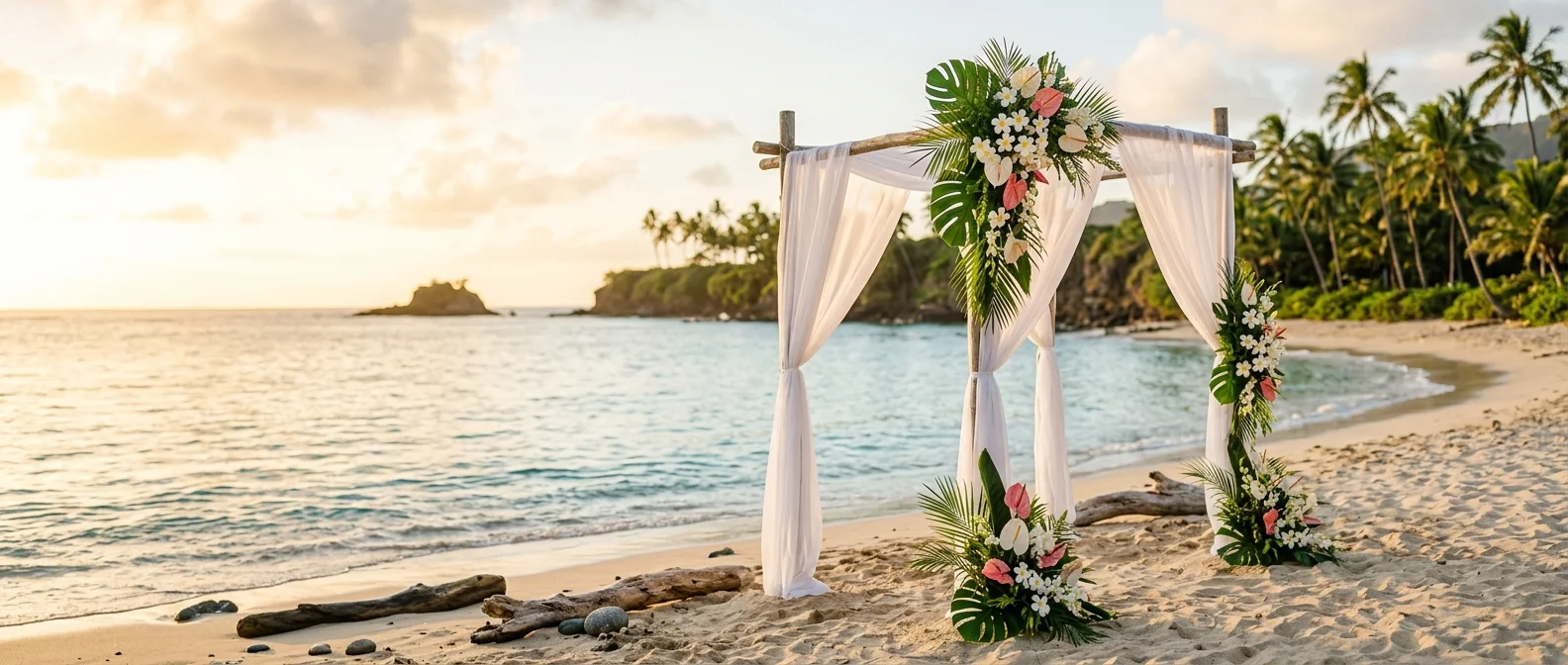
- Descriptive alt text on every image. Not "wedding-1.jpg" but "Wailea beach wedding ceremony arch with white draping and tropical flowers, Maui." Alt text drives image search and serves accessibility simultaneously.
- ImageObject schema markup on key gallery images, with name, description, contentUrl, and creator (photographer credit) properties. AI image search increasingly uses this to attribute and surface images.
- EXIF data retention. Many CMSes strip EXIF on upload; for wedding portfolios this is a real loss. Camera, lens, and date metadata help with image authenticity and freshness signals.
- Descriptive file naming. File names appear in image-search algorithms; "maui-beach-wedding-ceremony-2025.jpg" outperforms "IMG_4521.jpg" every time.
- Compression without quality loss. WebP at 80–90% quality typically delivers visually indistinguishable results at one-third the file size of unoptimized JPEG, dramatically improving Core Web Vitals and image-search ranking.
Pinterest SEO
Pinterest functions as a search engine for wedding planning. Pin titles, pin descriptions, and board names should be SEO-treated the same way meta titles are — keyword-relevant, descriptive, and aligned with how couples actually search. Vertical aspect ratios (2:3 minimum) and rich pin schema on the source pages boost both Pinterest reach and organic search visibility through Pinterest's outbound traffic.
Instagram + AI image search
Instagram functions as a second visual search engine for couples shortlisting Hawaii vendors. Hashtag strategy (location + style + vendor type), reel descriptions, and consistent posting cadence all influence discovery. AI image search — Google Lens, increasingly ChatGPT Vision — is becoming a third visual search layer, and vendors with proper image schema and consistent visual identity gain disproportionately as those systems mature.
6. Vendor Bio + E-E-A-T
The vendor bio page is a higher-stakes conversion surface for weddings than for most verticals. Couples are picking the people they will trust with the visual record and emotional logistics of a once-in-a-lifetime event coordinated remotely — credentials, experience, and authentic narrative all matter. See our E-E-A-T guide for AI search for the cross-vertical framework.
What a strong wedding vendor bio contains
- Years of experience and total weddings worked, with a representative sample (with permission).
- Specialization — Hawaii-island-specific, religious or cultural ceremony types, particular venue partnerships, photography style.
- Hawaii Wedding Professionals Association (HWPA) membership and any specialty certifications (WPICC, AACWP).
- Featured publication credits — Style Me Pretty, Junebug Weddings, Hawaii-specific bridal magazines, regional press.
- Authentic narrative — connection to Hawaii, family ties, multi-cultural experience, languages spoken (particularly relevant for international source markets).
- Person schema markup tying the bio to the vendor's portfolio gallery and any conditions / styles the vendor specializes in.
Why specialization beats generalization
A photographer whose bio specifies experience with Maui resort weddings, Japanese-language couple coordination, and 200+ Hawaii weddings shot converts better than one with a generic "Hawaii wedding photographer" bio. AI assistants surfacing "best [vendor type] [location]" recommendations weight specialization signals heavily — a specialist with 50 highly-specific portfolio examples outranks a generalist with 200 mixed examples.
7. How Should You Build a Multilingual Wedding Strategy?
Multilingual landing pages are the single biggest differentiator between vendors who capture international destination wedding demand and vendors who do not. The right level of localization depends on your actual booking-source data.
When localization pays off
A simple rule: if a source market represents more than 15–20% of your bookings, localizing for that market typically pays off in additional volume. Below 10%, the translation, ongoing maintenance, and platform-specific optimization costs rarely justify the lift. Between 10% and 15%, the math depends on your average booking value and the cost structure of your specific vendor type.
What proper localization includes
- Native-fluent translation, not machine translation. Cultural appropriateness matters as much as linguistic accuracy — ceremony language, gift conventions, family role descriptions all carry weight.
- hreflang tags correctly implemented (ja-JP for Japan, ko-KR for Korea, zh-CN for mainland China, zh-TW for Taiwan, en-AU for Australia).
- Locale-appropriate review surfacing — Japanese-language reviews displayed prominently on the Japanese landing page even if the practice has English-language reviews on the main site.
- Locale-aware booking forms — date format, name field structure, time-zone defaults, currency display.
- Content cadence in the target language. A Japanese landing page that has not been updated in 18 months reads as abandoned to Japanese couples, regardless of how recent the English-language content is.
Common localization mistakes
Three patterns we see repeatedly: (1) machine-translated pages with awkward phrasing that signals "we do not actually serve this market"; (2) hreflang tags missing or misconfigured, causing Google to treat the localized pages as duplicate content; (3) localized landing pages that route inquiries to English-only staff, breaking the trust the localization was supposed to build. Localization that works is end-to-end — content, schema, response, and ongoing maintenance.
8. Reputation Management Across Wedding Platforms
Wedding vendor reputation is fragmented across more platforms than almost any other vertical: Google, The Knot, WeddingWire, Zola Weddings, Junebug Weddings, Yelp, Instagram, Facebook. Each platform has its own review velocity dynamic, ranking algorithm, and response surface. See our review strategy guide for the cross-vertical foundation.
Platform priority order for Hawaii wedding vendors
- Google reviews. The foundation. Google's local pack ranking weight on reviews is well-documented; Hawaii wedding searches surface Google Business Profiles prominently.
- The Knot + WeddingWire. The two largest US wedding directories. Couples use these directly for vendor research and reviews, and the platforms feed back into Google through their own SEO authority.
- Junebug Weddings + Style Me Pretty. Editorial-focused platforms with high-authority feature placements. Less about review count, more about feature credits.
- Zola Weddings. Growing share of US wedding registries and increasingly vendor research; particularly strong with Gen Z couples.
- Yelp + Facebook. Lower priority but worth maintaining presence and active response. Yelp Hawaii has unusually high penetration in tourist markets — see our discussion in the restaurant marketing page for the underlying dynamics.
- Instagram. Less of a "review" platform and more of a portfolio + social proof platform — but inquiries reference Instagram presence routinely, so consistent posting is itself reputation work.
Review velocity vs portfolio depth
Wedding vendors hit a different review velocity ceiling than other verticals — most vendors do 30–80 weddings a year, capping monthly review velocity at 3–7 new reviews. The compensating factor is portfolio depth: detailed real-couple galleries (with consent-cleared schema), feature credits, and editorial coverage do conversion work that raw review count cannot match. Both matter; the right ratio depends on the vendor's stage and goals.
9. What a Comprehensive Wedding Marketing Engagement Covers
Wedding marketing is sustained, multi-platform, multi-language work. The framework below is how we structure a typical Nekko Digital engagement with a Hawaii wedding venue, planner, photographer, or vendor — three compounding phases, each building on the previous one. The wedding planning timeline is itself 12–18 months, so even a six-month optimization window can drive bookings for the next year's peak season.
Foundation
We open every wedding-vendor engagement by establishing the technical and structural baseline:
- Full audit of the vendor site, GBP, schema implementation, and NAP consistency across major wedding directories (The Knot, WeddingWire, Zola, Junebug Weddings).
- Implementation of LocalBusiness + Person + ImageObject + BreadcrumbList schema sitewide, with vendor-type-specific subtypes where applicable.
- Visual asset SEO across the existing portfolio — alt text, file naming, EXIF retention, ImageObject schema on key gallery images.
- GBP optimization: attribute completeness, photo libraries with geotags, weekly post cadence.
- Vendor bio audit and rewrite framework — specialization, HWPA membership, certifications, Person schema linkage.
- Baseline measurement framework: organic traffic by inquiry source, inquiry-to-booking conversion benchmarks, source-market mix.
Visual + Multilingual + Permit Content
Once the foundation is solid, we expand the addressable surface area:
- Pinterest SEO buildout — pin descriptions, board organization, rich pin schema on source pages.
- Permit and FAQ content — DLNR commercial use permits, county venue rules, marriage license process, package pricing transparency where appropriate.
- Japanese-language landing page (and Korean if booking data justifies) with proper hreflang, locale-appropriate visuals, and locale-aware inquiry forms.
- Real-couple gallery expansion with consent-cleared schema and proper image SEO across each feature.
- Multi-platform reputation push — Google, The Knot, WeddingWire, Junebug — with platform-appropriate review request automation.
Authority + AI Search
The third phase builds on that foundation:
- AI search visibility audit across ChatGPT, Perplexity, Gemini, and Claude — capturing baseline citation rates for the vendor name, specialization queries, and "best [vendor type] [location]" intent.
- Editorial outreach for feature placements on Style Me Pretty, Junebug Weddings, Hawaii bridal publications, and regional press.
- HWPA active membership with directory placement and any HWPA-specific content programs.
- Authority content — multi-month planning timelines, budget guides, source-market-specific guides — that captures earlier-funnel traffic.
- Ongoing measurement: monthly reporting on organic traffic by source, source-market booking mix, AI citation rate, and vendor bio conversion benchmarks.
Vendors wanting a self-administered baseline before engaging can start with our AI Search Self-Audit — a 41-point self-assessment that maps to many of the technical components above.
10. FAQ
What's the highest-leverage SEO move for a Hawaii wedding vendor?
Visual asset SEO — descriptive alt text, ImageObject schema, EXIF retention, and proper file naming on every gallery image. Wedding discovery is visual-first, and the vendors who treat their image SEO with the same care as text SEO win the inspiration phase that drives the entire booking funnel.
Are DLNR beach permits really necessary, and do they affect marketing?
Yes. Weddings on Hawaii state beach lands require Department of Land and Natural Resources (DLNR) permits, with specific guest-count caps and time-window rules. Couples search for permit information well before they book a venue or planner — vendors with clear, accurate permit content earn that early-funnel traffic and the trust that comes with it.
Should we localize for Japanese or Korean couples?
Look at your actual booking data. Historically Japan was Hawaii's largest international destination wedding source market, with gradual post-pandemic recovery; Korea has been growing. If international source markets represent more than 15–20% of your bookings (which they do for many established Hawaii vendors), Japanese-language and Korean-language landing pages typically pay off. Below that threshold, the lift rarely justifies the translation and maintenance cost.
What does the SEO work look like for a wedding vendor in the first year?
Plan the work in phases: the first 60–90 days go to technical foundations (visual asset SEO, schema, GBP, NAP across wedding directories like The Knot and WeddingWire), and topical authority on planning-stage content takes 6–12 months to build. The wedding planning timeline is itself 12–18 months, so even a 6-month optimization window can drive bookings for the next year's peak season.
How important is The Knot or WeddingWire presence vs SEO?
Important but secondary. The Knot and WeddingWire drive meaningful inquiries, but they take a cut of the funnel and do not own the customer relationship long-term. Treating them as a primary lead source is fine; treating them as a substitute for owned SEO and direct discovery is a margin trap. The right balance is presence on those platforms paired with strong organic and AI search visibility on your own site.
How does Lahaina recovery affect West Maui wedding marketing?
Materially. Vendors operating in West Maui need to communicate venue status, community context, and recovery participation accurately and sensitively. Generic "paradise" copy reads as tone-deaf to couples who have followed the news; specific, current, community-aware messaging earns trust. Many vendors have shifted operations toward South Maui (Wailea, Kihei) post-fire, which itself is a marketing reality to acknowledge.
Related resources
- Wedding Marketing — the industry positioning page this guide pairs with.
- Tourism Marketing — broader Hawaii destination demand framework.
- multi-island local search optimization — for vendors operating across Maui, Oahu, and Kauai.
- Content Strategy — multilingual content, planning-timeline guides, permit explainers.
- AI Search Optimization — strategy hub referenced throughout.
- AI Search Self-Audit — self-assessment for technical baseline.
- E-E-A-T Guide for AI Search — vendor bio and authority signal framework.
- Review Strategy Guide — multi-platform review velocity framework.
Want this implemented for your wedding business?
We work with Hawaii wedding venues, planners, photographers, florists, and the broader vendor ecosystem — across the full engagement framework above and ongoing optimization. Free vendor audit covers your current visual SEO, schema, GBP, multi-platform reputation, and AI search visibility baseline.
Get Your Free Wedding Vendor Audit →