
Google Business Profile: The Hawaii Field Guide
A Kailua plumber and a Waikiki poke shop both search "google business profile" tonight — and every guide they find assumes they operate in Ohio. They assume contiguous metros, a 50-mile service radius, one review playbook. Hawaii breaks all three. For most local businesses here, the Google Business Profile — not the website — is the first, and often the only, thing a customer sees before they call, drive, or scroll past.
This is the field guide for Hawaii operators ($1M–$50M, resident- or visitor-serving) who need their listing built correctly the first time: claimed, verified, island-scoped, and built to compete in the local 3-pack. It is the practitioner manual on top of our Hawaii local SEO services — last updated September 2026.
Why Your Google Business Profile Outranks Your Website in Hawaii
On a phone — where most "near me" searches happen — the local 3-pack and its map sit above the organic links. Your website is below the fold; your profile is the result. Whitespark's 2026 Local Search Ranking Factors survey puts proximity to the searcher at roughly 55% of the local-pack decision, with Google Business Profile signals the single largest controllable factor group at about 32%. (Those figures are Whitespark's national estimates, summarized from their 2026 edition — directional, not Hawaii-measured.)
Hawaii leans harder on this than the mainland. Search here is overwhelmingly mobile, overwhelmingly "near me," and — on the neighbor islands — overwhelmingly driven by visitors who landed an hour ago and will never see your homepage. The profile is the storefront. The rest of this guide is how you stock it.
Where GBP Lives in the Reef: Substrate and Citations
We organize search work as a reef. A verified, structurally correct Google Business Profile is the Substrate layer — foundation infrastructure, like a crawlable site or clean schema. Nothing above it compounds until the base is right: a profile with the wrong category, an unverified address, or inconsistent hours quietly caps everything you build on top of it.
Everything that radiates outward from the profile — NAP consistency across directories, reviews, and the citations that AI engines read — is the Citations layer. The profile is the seed citation: the canonical, Google-trusted statement of who you are and where you are, from which the rest of your local authority grows.

Claiming and Verifying Your Profile, Island Edition
If you're wondering how to claim a Google Business Profile: search your business name, select "Claim this business," and Google walks you through ownership verification — increasingly by video. The mechanics are the same everywhere. What trips up Hawaii businesses is the address and the verification footage, where island realities collide with Google's mainland-built rules.
Video Verification: What Google Asks For
Google's current standard is a single, unedited video — at least 30 seconds (aim for one to two minutes), recorded live from your phone inside the profile, no offline uploads. It must show three things: your location (street signs, building numbers, nearby landmarks), your business existence (permanent signage on a wall, window, or board), and your authorization (something only an owner or staffer could do — open the register, the kitchen, the back room, the POS). Keep bank details, IDs, and other people's faces out of frame. Google returns a result within about five business days.
No Storefront? Setting Up a Service-Area Business
Plumbers, cleaners, landscapers, and mobile operators run as a service-area business (SAB): you verify with a real address but hide it, then declare the areas you serve. Home-based operators must still verify a genuine address — the video shows the location, then you toggle the address private. This is the most common Hawaii setup and the one mainland guides handle worst.
PO Boxes, Kōkua Lines, and Other Hawaii Address Pitfalls
Google rejects PO boxes and mail-forwarding addresses outright — common here given inter-island logistics, and a frequent suspension trigger. Multi-tenant commercial buildings in downtown Honolulu need a suite number and clear signage or the video fails. And a virtual office or a UPS-store mailbox will get a profile suspended on review. Verify with a location you can physically film a person working at — that single rule prevents most Hawaii verification headaches.
Choosing Categories: A Taxonomy for Hawaii Business Types
Category choice decides which searches your listing is even eligible to appear in — it is the highest-leverage field on the profile. Your primary category should name your single most important revenue activity exactly; secondary categories extend reach into adjacent intents without diluting the primary. Among local-SEO practitioners — Sterling Sky's Joy Hawkins prominent among them — the primary category is consistently named the single highest-impact edit, and it matches what we see. Pick precisely, then add secondaries that a real customer would search.
Hawaii's business mix doesn't map cleanly onto Google's category list, so here's a starting taxonomy for common island types. Treat these as a guide — always confirm the exact wording against the live category picker and match it to what you actually do most.
| Hawaii business type | Recommended primary | Useful secondaries |
|---|---|---|
| Vacation-rental manager | Vacation home rental agency | Property management company · Holiday apartment rental |
| Lūʻau / activity operator | Tour operator | Tourist attraction · Event venue |
| Food truck | Food truck | Hawaiian restaurant · Takeout restaurant · Caterer |
| Solar contractor | Solar energy contractor | Electrician · Roofing contractor |
| Shave-ice stand | Shaved-ice shop | Dessert shop · Snack bar |
| Dental clinic | Dentist | Cosmetic dentist · Pediatric dentist |
| Law firm (PI lead) | Personal injury attorney | Trial attorney · Law firm |
| Boutique inn / B&B | Bed & breakfast | Inn · Boutique hotel |
| House-cleaning service (SAB) | House cleaning service | Commercial cleaning service · Janitorial service |
Recommended starting categories — verify each against Google's live category list before publishing.
Multi-Island Profile Architecture: One Business, Several Islands
This is the section no mainland guide can write, because their geography is contiguous and ours is not. The governing dynamic: Google ranks by proximity — its own documented factor — and in our practice we see no meaningful local-relevance bleed across an ocean channel. A Maui profile will not rank in a Honolulu search no matter how perfect it is; we consistently watch the same business, at the same profile quality, rank in the pack on its home island and nowhere on the next one over. (That cross-channel pattern is our field observation, not a published constant.)
Storefront on Two Islands: Separate Profiles, Separate Pages
A cleaning company with offices in Kahului and Honolulu needs two profiles — not one "service area" stretched across the channel. Each profile is island-scoped, with its own categories, photos, hours, and reviews, and each should point to an island-specific landing page rather than a generic homepage. That destination pattern is exactly what our Honolulu local SEO page and the other island pages exist to be: the on-site half of the per-island profile.
SAB Service Areas Stop at the Shoreline
A service-area business cannot "serve a 50-mile radius" when 50 miles is open water. Declare service areas island-by-island — cities, towns, and regions within the island the profile is verified on. A radius tool will happily draw a circle over the Pacific; ignore it and list real localities (Kailua, Kāneʻohe, Pearl City) instead. A multi-island SAB therefore needs one profile per island it genuinely services, each with its own in-island service-area list.
Which Island Gets the Primary Profile?
Verify your primary profile where you have the strongest physical presence and the most review history — usually your home island and densest demand. Oahu (Honolulu County) holds roughly 69% of the resident base, so resident-serving operators often anchor there; a visitor-serving operator may anchor on the island where its bookings concentrate. The four counties — Honolulu, Maui, Kauai, and Hawaiʻi (Big Island) — are administratively distinct, and that boundary is the right mental model for profile separation.
| Scenario | Profiles | Address shown? | Service area | Each profile links to |
|---|---|---|---|---|
| Single storefront, one island | 1 | Shown (verified street address) | Not used (storefront) | That island's location page (e.g. /locations/honolulu/) |
| Storefronts on 2+ islands | 1 per storefront | Shown on each | Not used | Each profile → its own island page |
| SAB serving one island | 1 | Hidden | Cities / regions on that island only | That island's location page |
| SAB serving multiple islands | 1 per island served | Hidden | Scoped within each island — a radius crosses ocean | Each profile → its island page |
| Hybrid (storefront + wider reach) | 1 (storefront, service areas added) | Shown (storefront) | Storefront island + reachable areas on the same island | Storefront island's location page |
Find your island: we run dedicated local SEO pages for Honolulu, Oahu, Maui, Kauai, Big Island, Waikiki, Kailua, Kapolei, Hilo, Lahaina, and more — one destination per island profile.
Optimizing Every Section of the Profile
Once the profile is verified and categorized, the work is to optimize your Google Business Profile field by field. GBP signals are the largest controllable factor group Google reads — Whitespark puts the group near 32% — and completeness is how you max them out. This is the structural pass; for the deeper tactical playbook (description formulas and post templates), see our dedicated GBP optimization guide.
Photos and Visual Proof
In Hawaii the visual landscape is itself a ranking variable — a visitor scrolling "oceanfront restaurant Waikiki" compares profile photos directly, side by side. Add fresh, geo-relevant photography on a weekly cadence; in our experience, profiles refreshed weekly tend to out-engage those updated monthly or quarterly. Shoot your real space, your real food, your real crew — stock imagery reads as exactly what it is.
Services, Products, and Attributes
Fill the services and products lists completely — each entry is a query you become eligible for. Attributes are quietly powerful in Hawaii: "Languages spoken" surfaces you to Japanese- and Korean-source-market searchers, and we routinely find listings with bilingual front desks but English-only attributes — invisible to the exact market they're staffed for. Mark accessibility, payment, and amenity attributes honestly; they feed filtered searches.
Google Posts and Ask Maps
Post weekly — offers, events, seasonal updates — so the profile reads as "alive"; Google increasingly rewards active profiles with engagement-driven freshness. Google retired the Q&A API in November 2025 and began removing the public section from December; customers now ask in Google Maps, where Google says answers are based on your answers and relevant reviews. Third-party sources describe a longer list. In January 2025, more than a year before Google introduced Ask Maps, Mike Blumenthal tested "Ask Maps about this place," an AI feature on business profiles that Google first announced in October 2024. He reported in Search Engine Journal that Google appeared to rely first on the profile, reviews and the business website, and also used photos uploaded to the profile. BrightLocal's guide, updated in April 2026, says Ask Maps draws on your profile details, reviews and website. Google hasn't confirmed either list. Put the questions customers actually ask (parking, hours during a swell, whether you serve a given island) in an FAQ on your website, marked up with FAQ schema.
Reviews in a Visitor Economy: Tourists vs. Residents
Reviews are the largest controllable ranking lever after the profile itself — Whitespark's 2026 survey puts review signals at roughly 16–20% of weight, with recency climbing fast. BrightLocal's 2026 consumer survey adds the demand side: 97% of consumers read reviews for local businesses, 71% use Google to do it, and 74% specifically want reviews from the last three months. Stale review stores read as neglected to customers and to Google alike.
Hawaii runs two review economies at once. A Waikiki restaurant or a Maui activity operator collects high visitor volume — but visitors review once and never return, and arrivals swing seasonally (Oahu drew roughly 527,000 visitors in a single month against about 996,000 residents; on Maui, monthly visitors of ~236,000 rival a resident base near 164,000). That produces winter-peak velocity that fades in shoulder season. A Kāneʻohe dental practice lives on slower, stickier resident reviews that compound year-round.
So the review strategy differs by type: visitor-heavy businesses need a year-round collection cadence to survive the spring drop-off and should ask at the moment of delight (post-tour, post-meal); resident-serving businesses build a durable graph more slowly and benefit from asking in the customer's language. The full playbook — timing, scripts, recovery — lives in our complete review strategy playbook.
Local Citations: Extending the Profile Across the Web
A local citation (definition) is any place your business name, address, and phone appear online — directories, chambers, listings. Their raw ranking weight is declining nationally (Whitespark marks them materially less impactful than five years ago), but NAP consistency still matters: contradictory addresses or old phone numbers across the web erode the trust your profile establishes. This is the Citations layer doing its job — confirming, everywhere, what the profile asserts once.
In Hawaii the citation set that matters is small and namable, which makes it tractable: Hawaii.com, Honolulu Magazine, Hawaii Business Magazine, the Star-Advertiser business listings, the Hawaii Better Business Bureau, and the county chambers (Honolulu, Maui, Kauai, Hawaiʻi Island). For visitor-facing businesses, TripAdvisor, GetYourGuide, and visitors-bureau-affiliated sites function as near-required local citations. A handful of accurate, authoritative Hawaii listings outperforms a hundred generic national-aggregator entries.
How Google Maps Ranks Hawaii Businesses
Proximity, Relevance, Prominence
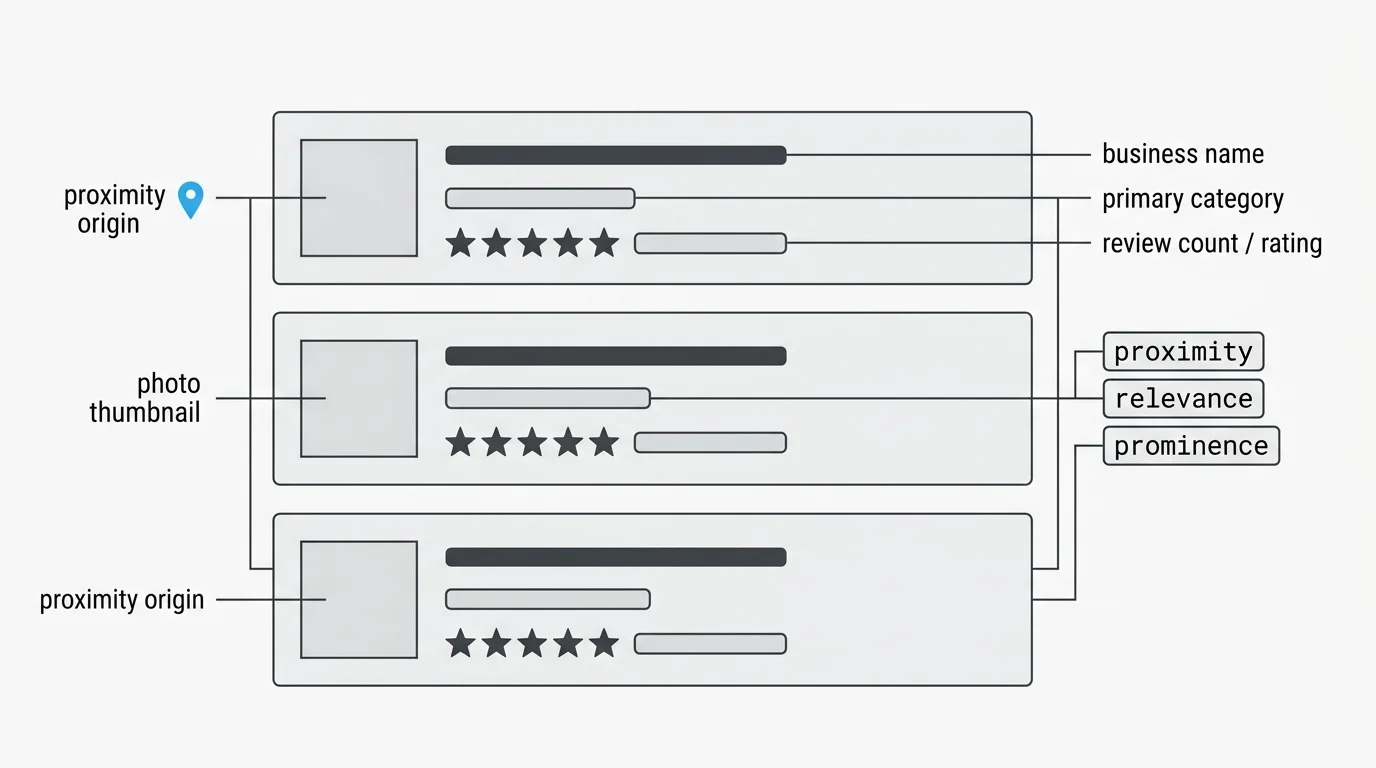
Google documents three local ranking dimensions. Proximity is how close you are to the searcher. Relevance is how well your profile — categories, services, content — matches the query. Prominence is how known and trusted you are, from reviews, citations, links, and offline reputation. Knowing how to rank in Google Maps means working the two you control, relevance and prominence, because the third is set by where the searcher is standing.
Why Proximity Behaves Differently on an Island
On the mainland, proximity zones are roughly circular. In Hawaii, in our field experience, they compress and stretch. Dense Honolulu compresses them — a few blocks can decide the pack, and the address you verify with materially changes which neighborhoods you appear in. On rural Big Island the nearest qualifying business might be 30 minutes away, so proximity stretches and a single profile can own a wide area. For a service-area business, that makes your verified address (the centroid Google measures from) a strategic choice, not an afterthought — and the cleanest google maps optimization lever you have. Our 2026 study of Hawaii local pack ranking factors covers how proximity reshapes rankings here.
Measuring What the Profile Earns You
The profile's own performance view reports the numbers that matter: calls, direction requests, and clicks to your website, broken down by the searches that triggered them. Tag the website link with UTM parameters so those clicks show up in your analytics as profile-sourced, not "direct" — otherwise you under-count the channel and over-credit everything else. Read the numbers against the visitor economy, too: on the neighbor islands, direction requests often spike from off-island searchers planning before they fly in, and call and click trends swing with arrival seasonality — so compare month-over-month against the visitor calendar, not a flat baseline.
To turn calls and clicks into dollars, run them through our free local SEO ROI calculator: enter your close rate and average job value, and it estimates what local-pack visibility is worth. As an illustrative model — not a client outcome — our Hawaii home-services scenario projects how moving roughly 60% of lead volume off paid search and onto the owned 3-pack could recover on the order of $43,000 a year for a single-trade operator. Your numbers will differ; the point is that the profile is a measurable revenue channel, not a vanity listing.
Frequently Asked Questions
How do I claim my Google Business Profile?
Search your business name on Google, then choose "Claim this business" — or create a new listing at google.com/business if none exists. Google asks you to verify ownership, usually by video. Once verified, you control the profile's information, photos, posts, and review responses.
How long does Google Business Profile verification take in Hawaii?
Video verification typically returns a result within five business days of uploading the recording. There is no Hawaii-specific delay — but a clear video showing your signage, the surrounding location, and owner-only access (a register or back room) is what earns approval on the first attempt.
How do I optimize my Google Business Profile?
You optimize a Google Business Profile by completing every field and keeping it active: pick the most accurate primary category, fill the description, services, attributes, and hours, add fresh geo-relevant photos weekly, and post regularly. Google retired the Q&A API in November 2025 and began removing the public section from December, so answer common customer questions in a website FAQ with FAQ schema instead. For the deep tactical pass, read the tactical GBP optimization playbook.
How do I rank higher in Google Maps?
Proximity to the searcher is the largest factor, so you cannot out-optimize geography — but among nearby businesses, a complete profile, accurate categories, steady recent reviews, and consistent citations decide the order. In Hawaii, a profile only competes on its own island.
What are local citations and why do they matter?
A local citation is any online mention of your business name, address, and phone — in directories, chambers, and listings. Consistent citations confirm your business is real and located where you say, which supports Maps trust even as their raw ranking weight declines.
Should a Hawaii business with customers on multiple islands have one profile or several?
Several. Each island needs its own profile, because Google ranks by proximity and an Oahu profile cannot rank in a Maui search. Storefronts get one profile per location; service-area businesses get one per island, with service areas scoped within that island — never across the channel.
Is Google Business Profile free?
Yes. Creating, verifying, and managing a Google Business Profile costs nothing — there is no paid tier for the listing itself. You only pay if you choose to run Google Ads or hire someone to manage it. The profile, reviews, posts, and Maps presence are all free.
Does my Google Business Profile affect whether AI tools recommend my business?
Indirectly, yes. A complete, well-reviewed profile feeds the same authority signals — reviews, structured data, consistent citations — that AI engines weigh when recommending businesses. We track which Hawaii businesses AI engines cite in the Reef Citation Index.
The Field Guide Tells You What to Do. We Do It.
This guide covers how to build and rank the profile. Nekko's Local SEO practice runs it for you — per-island profile architecture, review systems, and citation cleanup for Hawaii businesses. Want it handled?