
Top 3 on Google Maps? AI Mode May Not Show You
In a June 2026 study, 28.5% of businesses in Google's top 3 map results didn't appear in AI Mode for the same search. What it means and how to check.

By Rodrigo Diniz Published
Digital Marketing Specialist & Founder
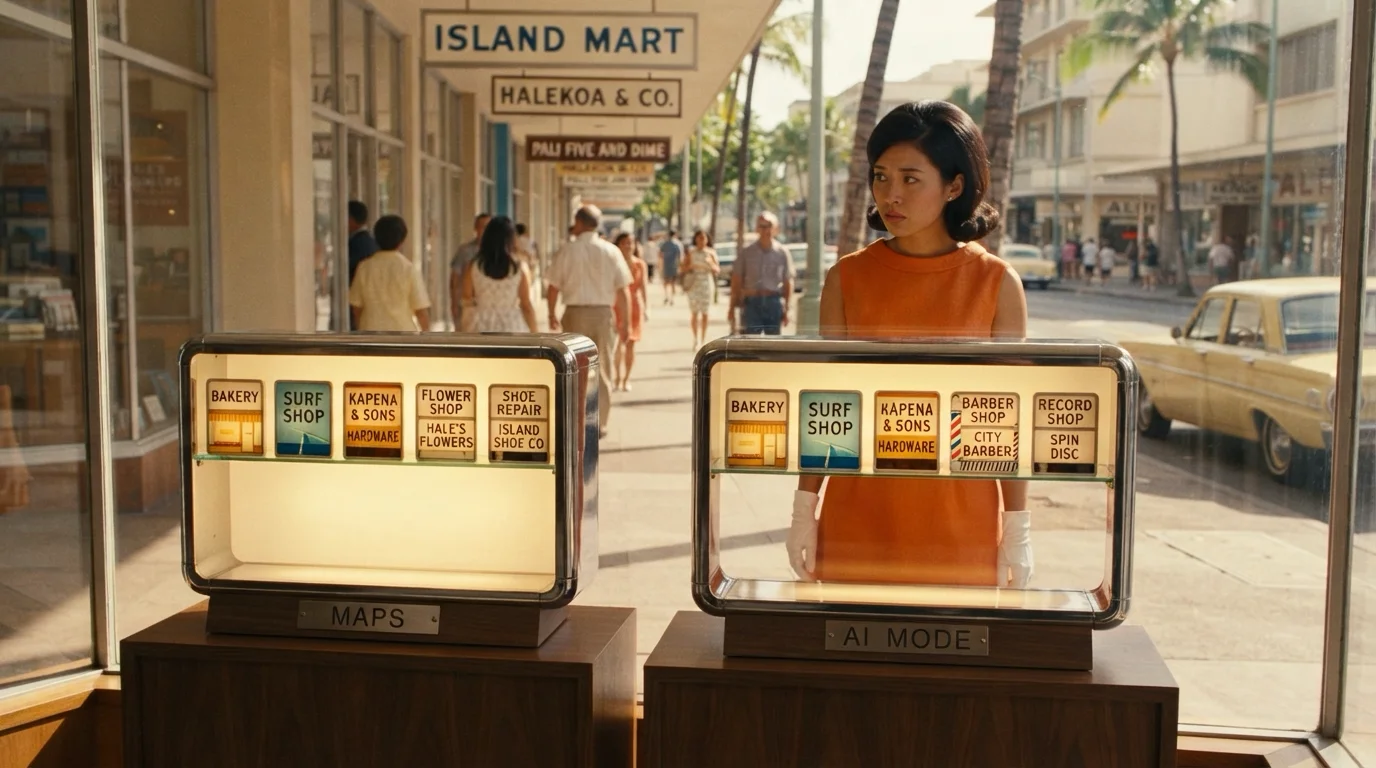
For many local searches, Google shows a map with a box of three businesses, often called the local pack. For local business owners, a spot in those top 3 map results is a good sign, but it doesn’t mean Google’s AI Mode will show you for the same search. In a June 2026 study by Local SEO Data, 28.5% of the businesses in the top 3 map results, more than 1 in 4, didn’t appear in AI Mode. AI Mode wasn’t showing fewer businesses; it was showing a different set.
If you’re new to it, Google AI Mode is the conversational tab in Google Search that writes an answer instead of listing links. Here’s what the study measured, how the two lists differ, how to check your own business, and what to fix first.
What the Local SEO Data Study Measured
Which Searches and Businesses Were Compared
The study was written by Noah Owsiany and published on June 2, 2026. Local SEO Data sells a tool that pulls AI Mode results automatically (an API), and it ran the study with that tool.
The team ran 1,120 local search queries from May 20 to 22, 2026, in seven industries (plumbers, dentists, HVAC, chiropractors, lawyers, restaurants and medical specialists) and 13 U.S. cities, from Syracuse and Boise to Houston and Los Angeles. None was in Hawaii.
Each search ran in both AI Mode and regular Google Search. The study compared the businesses AI Mode showed with the top 3 map results only, not with every business on Google Maps, and it didn’t test the Google Maps app. The searches ran through the company’s tool, so they weren’t tailored to anyone’s search history or exact location.
What “Not Showing Up” Means in This Study
Of the businesses in the top 3 map results, 71.5% also appeared in AI Mode for the same search. The other 28.5% didn’t appear anywhere in AI Mode’s results for that search. The study matched the businesses it pulled from AI Mode’s answers against the map results by name, but it doesn’t say whether a business mentioned only in the text of an answer counted.
That detail matters because AI Mode can show a business in more than one way: as a place card, a business listing the study describes as having star ratings, review counts and a call button, or by name in the text. When it skipped the cards, the study found it still named businesses in the text 98% of the time.
What the 28.5% Tells You, and What It Doesn’t
- Who ran it. The company that sells the data tool ran and published the study itself, so this is a vendor’s research, not an independent review.
- Where. Thirteen cities on the U.S. mainland. There’s no Hawaii data, so it can’t tell you how often this happens on Oahu, Maui or anywhere else in the islands.
- When and why. It’s a snapshot from three days in May 2026 that shows a pattern, not a cause, and the study notes that Google updates AI Mode regularly.
- What it isn’t. It’s not a count of lost customers. It measured which businesses appeared, not who got the call.
The study treated unclear business-name matches as misses, so it says the overlap may be slightly undercounted. It also doesn’t cover the AI-powered local packs that Joy Hawkins of Sterling Sky has reported seeing on mobile in the U.S., on about 7% of the keywords her team tracks. The study didn’t measure those.
Same Local Search, Two Different Shortlists
What a Customer Sees in Each
For a local search like “dentist Houston,” one of the study’s examples, the map results show three businesses on a map, while AI Mode answers in a conversational format. When Google added place cards to AI Mode in May 2025, it said people would see ratings, reviews and opening hours for local spots, with options to call or get directions. The study found those cards don’t always appear; sometimes businesses are named in the text instead.
A Longer List, With Different Businesses
In a typical search, AI Mode’s list was longer, and it wasn’t made up of the same businesses. It showed a median of 5 businesses per search (the middle figure across all searches), against the map results’ fixed 3. So the study also compared like with like, AI Mode’s top 3 against the map’s top 3, and found that only 48% of those businesses were the same.
The other figures point the same way:
- In 57% of searches, at least one of the top 3 map businesses didn’t appear anywhere in AI Mode.
- Only 40.6% of the businesses AI Mode showed were in the top 3 map results.
- AI Mode showed 999 businesses that never appeared in the top 3 map results. The study notes that some of them may sit in the longer “More places” list below the map box, which it didn’t check.
Does a Top-3 Spot in Google’s Map Results Still Matter?
Most Top-3 Map Businesses Also Show Up in AI Mode
By this study’s numbers, yes. Most businesses in the top 3 map results, 71.5%, also appeared in AI Mode. In 42.7% of searches all three did, and in 6.2% none did. The study’s own conclusion is that the map results haven’t stopped mattering.
But a top-3 spot isn’t a gate to AI Mode or a guarantee of a place in it. AI Mode also showed plenty of businesses from outside the top 3, so the two lists are worth checking separately.
Where the Two Lists Agree, and Where They Don’t
The overlap wasn’t the same everywhere. By industry, the share of top-3 map businesses that also appeared in AI Mode ranged from 76.6% for HVAC to 67.4% for medical specialists:
| Industry | Top-3 map businesses also in AI Mode |
|---|---|
| HVAC | 76.6% |
| Dentists | 72.9% |
| Restaurants | 71.2% |
| Lawyers | 70.8% |
| Chiropractors | 68.9% |
| Plumbers | 68.0% |
| Medical specialists | 67.4% |
By city size, the small metros in the study (Syracuse, Boise and Chattanooga) overlapped most, at 78.9%, against 68.9% for mid-size metros and 71.0% for large ones. The study’s explanation is that fewer businesses compete for each search in smaller markets, so both lists draw from a smaller pool.
The businesses differed in one more way. The typical business found only in AI Mode had more reviews than the typical business found only in the map results (a median of 358 against 240), with almost identical star ratings. That pattern reversed for lawyers and medical specialists, and the study says it can’t tell whether reviews cause better AI Mode visibility or simply come with a stronger online presence.
Why a Business Appears on the Map but Not in the Answer
The study didn’t test why a business appears in one list and not the other, but Google does explain how each list works. For the map, Google says local results are based primarily on relevance, distance and prominence, which its Business Profile help describes as how well a profile matches the search, how far the business is from the searcher, and how well known it is. Our Google Business Profile guide covers how that plays out in Hawaii, in its section on how Google Maps ranks Hawaii businesses.
What the AI Answer Has to Work With
Google says less about AI Mode. Its help page says AI Mode breaks a question into subtopics and searches for each one “across multiple data sources.” Google’s guidance on AI features in Search says AI responses can include “information about local businesses,” and that Google Business Profiles “can help your products and services to be visible in both AI responses and other Google Search results.” Google hasn’t said how AI Mode chooses which businesses to name, or how that relates to the map results.
When Your Profile and Your Website Don’t Line Up
Google says it uses business information to surface local results “across Google, such as in Google Maps and Search,” and that its sources include “information from a business’ official website.” If your profile and website disagree on hours, services or the area you serve, Google has two versions of the same facts, and it hasn’t said how AI Mode handles a mismatch like that. Structuring that information so search engines and AI tools can use it as a direct answer is the work of answer engine optimization.
How to Check Whether AI Mode Leaves Your Business Out
Search the Way Your Customers Do, Then Compare Both Lists
You can run a rough version of this check yourself. Take the search a customer is most likely to type and try it four ways: the plain service (“plumber”), then with “best,” with “near me” and with your town’s name. Wording mattered in the study. In its first round of searches, across five industries and 10 cities, AI Mode showed any place cards at all for 74.7% of plain searches, 84.0% with “best,” 95.3% with “near me” and 92.0% with a city name.
For each version, write down the top 3 map businesses and every business AI Mode shows. Your own map results depend on where you’re searching from, because distance is part of how Google ranks local results. The study’s searches had no precise location, so treat yours as a spot check, not a repeat of the study.
Check What the Answer Says About You, Not Just Whether You’re Named
If your business does show up, read what the answer says, and compare the hours, services and area it mentions with your Google Business Profile and website. Google’s help page warns that “AI responses may include mistakes” and tells people to “check important info in more than one place.”
Run the Check More Than Once
One search on one day doesn’t tell you much. The study found that which specific businesses appear can change from day to day, even though the overall patterns held, and that the effect of wording shifted within its three days of data collection. Repeat the same searches on a few different days before you conclude AI Mode is leaving you out.
A similar check works in ChatGPT, and the 41-point AI Search Self-Audit looks at your website itself. For AI assistants more broadly, our own research on AI visibility measures which Hawaii businesses they name when a buyer asks for a recommendation. Its published benchmark measured Claude, and we run the same method on other assistants on request.
On the Map but Missing From the Answer? What to Fix First
The study didn’t test fixes. These are the basics we’d check first.
Make Your Google Business Profile and Website Say the Same Thing
Spell out your services, service area and hours on your website, and make sure they match your Google Business Profile. Google says businesses with complete and accurate info “are more likely to show up in local search results,” and your website is the one place where you control every detail.
Give Other Local Websites a Reason to Mention You
Local press, your chamber of commerce and neighborhood groups are natural places for a local business to be mentioned. Google hasn’t said whether mentions help a business appear in AI Mode, so treat this as part of being well known locally. If you’d like help with the ongoing work, generative engine optimization is our service for competing to be named in generative AI answers. If you’d rather do it yourself, our AI Search Playbook lays out a 30-day plan.
Not on Google Maps at All? Start There
If your business doesn’t have a Google Business Profile yet, set one up first: it’s the basic step to being found locally. Our get-found plans set up and complete your profile and keep posting to it, and the Pro plan adds work to make your site readable by AI assistants like ChatGPT and Google’s AI.
Frequently Asked Questions
What did the Local SEO Data study find about Google’s map results and AI Mode?
In a June 2026 study that compared AI Mode with Google’s top 3 map results for the same searches, 28.5% of the businesses in the top 3 map results didn’t appear in AI Mode, and 71.5% did. Local SEO Data, which sells a tool for pulling AI Mode results, ran the study.
Why would my business show in Google’s top map results but not in AI Mode?
The study didn’t test causes, and Google hasn’t said how AI Mode picks businesses. Google says map results are based mainly on relevance, distance and prominence, while AI Mode searches across multiple data sources, so the two lists are built differently. A good first check is whether your Google Business Profile and website give the same hours, services and service area.
How can I check whether AI Mode leaves my business out?
Search for your main service four ways: plain, with “best,” with “near me” and with your town’s name. Compare the top 3 map businesses with the businesses AI Mode shows, and repeat on different days, because results can shift.
Did the study include Hawaii businesses?
No. It covered 13 cities on the U.S. mainland, with no searches in Hawaii, so it has no Hawaii figure and this post doesn’t estimate one. Our own published research measured Claude, not AI Mode, so we don’t have a Hawaii AI Mode figure either.
Does AI Mode show fewer businesses than Google’s map results?
Not in this study. AI Mode showed a median of 5 businesses per search, against the map results’ 3, and when the study compared top 3 with top 3, only 48% of the businesses were the same. AI Mode showed a different set of businesses, not a shorter list.
Rodrigo Diniz
Digital Marketing Specialist & Founder
Digital Marketing Specialist & Founder at Nekko Digital with 15+ years in SEO, web design and AI search optimization.