
Google AI Mode, Explained for Hawaii Businesses
Google AI Mode is rewriting how customers find Hawaii businesses. Plain-English explainer of what it is, how it ranks sources, and what to do next.

By Rodrigo Diniz Published Last updated
Digital Marketing Specialist & Founder
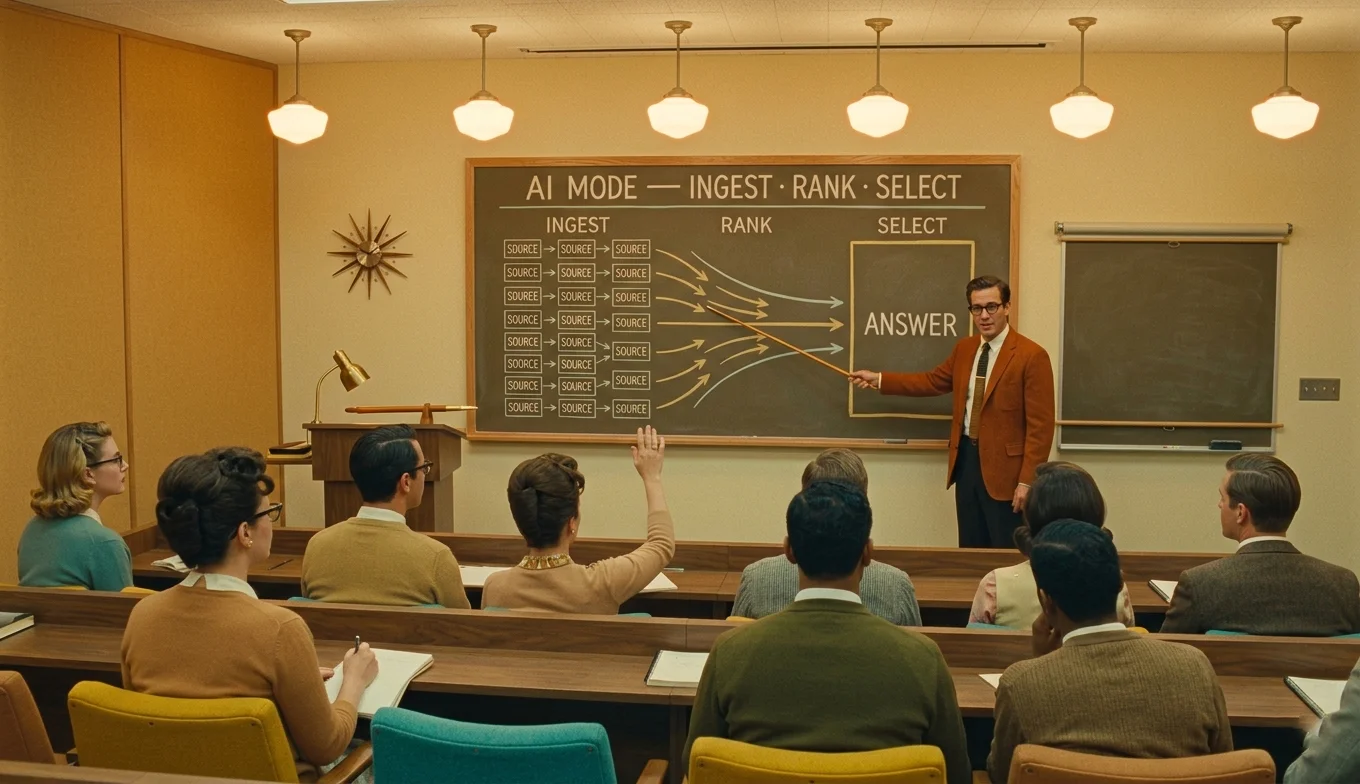
A visitor in Honolulu opens Google and types “best family lūʻau on Oʻahu.” A year ago they would have scanned ten blue links and clicked around. Today, in Google AI Mode, Google answers the question itself: a few conversational paragraphs that name a handful of lūʻau, with small cited sources attached, and a prompt to ask a follow-up. The visitor reads the answer, taps one of the names, and books. No list. No scrolling. One of those businesses got the booking — and in that moment, the only businesses that existed were the ones Google chose to name.
In a June 2026 study of local searches in 13 U.S. mainland cities, AI Mode showed a median of five businesses per search. Across the 649 searches where both Google’s top-3 map results and AI Mode returned businesses, 28.5% of those map businesses did not appear in AI Mode for the same search (Local SEO Data, which ran the study on the AI Mode API it sells). The study doesn’t say whether a business named only in the text of an AI Mode answer counted as appearing.
That shift — from a page of ranked links to a single composed answer — is the most important change in how people find local businesses since the map pack arrived. This is a plain-English explainer of what AI Mode is, how it decides who to name, and, specifically, what it means for a business operating in Hawaii. We will keep it to the what and the why; the step-by-step tactics live elsewhere, and we will point you to them.
What Is Google AI Mode?
Google AI Mode is a dedicated conversational tab inside Google Search. Instead of returning a ranked list, it uses Google’s Gemini model to compose a complete answer to your question, attach citations to the sources it drew from, and let you ask follow-up questions in the same thread — the way you would in a chat tool, but wired directly into Google’s index of the live web.
It did not appear out of nowhere. The lineage runs through three steps: the Search Generative Experience (SGE), a 2023 Google Labs experiment; AI Overviews, the summary blocks that began appearing above normal results in 2024; and AI Mode itself, which moved from Labs into general availability around Google I/O in May 2025, announced by Liz Reid, Google’s Head of Search. Each step pushed AI further up the page and gave it more of the answer.
Because this surface is changing month to month, dates matter. Everything in this post reflects how AI Mode behaved as of mid-2026; if you are reading it much later, the mechanics described here will have moved on, and so should your strategy.
AI Mode vs. AI Overviews vs. Classic Search
The single most common confusion is between AI Mode and Google AI Overviews. They are not the same feature. AI Overviews is a summary block bolted onto the top of the classic results page — you still get the ten links underneath. AI Mode is a separate, fully conversational experience you choose to open, where the answer is the page.
Here is the comparison we hand clients on day one:
| Classic Search | AI Overviews | AI Mode | |
|---|---|---|---|
| Where it appears | The standard results page | A block at the top of classic results | A separate conversational tab you open |
| What you see | Ten ranked links | An AI summary, then the links below it | A composed answer plus follow-up prompts |
| How sources show | Each result is its own listing | A few cited links beside the summary | Inline citations attached to specific claims |
| What a “click” means | The main path to a website | Optional — many users stop at the summary | Often zero-click; the answer is the destination |
| What decides who appears | Rankings: links, relevance, authority | Index + extractability + authority | Index + extractability + authority + entity clarity |
The practical takeaway: classic ranking and AI citation are related but not identical. A business that ranks fifth on the classic page may be named in the AI answer — or skipped entirely — depending on how cleanly an engine can extract and trust its information. Getting cited in each surface is its own playbook: we cover the tactics step by step in How to Rank in Google AI Mode and its companion How to Rank in Google AI Overviews. This post stays on the what and the why.
How AI Mode Builds an Answer: Query Fan-Out in Plain English
The mechanism behind AI Mode has an unglamorous name — query fan-out — and understanding it changes how you think about visibility.
When you ask AI Mode a question, it does not run one search. It quietly issues several related background searches, then has Gemini read across all of those results and synthesize a single answer, attaching citations to the individual claims as it goes. Ask “best family lūʻau on Oʻahu” and behind the scenes Gemini may run separate searches for prices, locations, reviews, and current availability, then weave the strongest, most consistent sources into one response.
Query fan-out is why AI search rewards a different shape of presence than the classic ten links did. With one ranked query, you compete on one phrase. With query fan-out, you can be cited for a sub-question you never knew you were competing on — “which lūʻau are good for young kids,” say — because Gemini went looking for that angle on its own and found you had answered it clearly somewhere on your site. The flip side is just as true: if your site never answers the sub-questions in plain, extractable language, you are invisible to half the searches that make up the final answer.
There are no tactics in this section by design — only the mechanism. What to do about it is the next two sections, and the deeper how-to lives in the manual linked above.
What AI Mode Looks Like in Hawaii Right Now
This is where a national explainer stops being useful and a Hawaii one starts. Every mainland agency can paraphrase Google’s announcements. What they cannot show you is which Hawaii businesses AI engines actually name — because they do not measure it here. We do.
What our Hawaii AI-citation research found
We publish the Hawaii AI Search Visibility Index, an open-methodology dataset measuring which Hawaii businesses AI engines cite for the queries real customers ask. The benchmark (May 2026) ran a 50-query universe and cross-validated every cited business against public sources — TripAdvisor verified properties, Honolulu Board of REALTORS market data, and hospital records. Here is the shape of what it found:
| Category | Who Hawaii’s AI answers tend to name | The pattern behind it |
|---|---|---|
| Hotels & resorts | Brand-anchored luxury — Four Seasons (Maui, Hualālai), Halekulani, The Royal Hawaiian, Aulani | Accumulated press, awards, and review depth win; independent boutiques without sustained coverage are underrepresented |
| Restaurants | Mama’s Fish House (the single most-cited restaurant statewide), Hawaii Regional Cuisine chefs, long-tenured locals like Helena’s and Rainbow Drive-In | Citations track longevity and press recognition, not current operations |
| Tours & activities | One leader per niche — Pacific Whale Foundation, Body Glove, Atlantis, Blue Hawaiian | A single operator owns each niche; newcomers face a real authority moat |
| Real estate | Statewide brokerages like Hawaii Life; the Honolulu Board of REALTORS’ $1,199,500 single-family median surfaces for market questions | Neighborhood-level agents rarely surface without deeper web signals |
| Healthcare | Hospital systems — Queen’s, Hawai‘i Pacific Health | Specialty and neighbor-island practices are largely absent — a genuine gap |
| Weddings | Resort venues | Individual planners, photographers, and florists surface unevenly |
| Home services | Almost no one — a “citation desert” | Named contractors, cleaners, and trades don’t surface; the AI falls back to generic advice |
A note on scope, because it matters: the published benchmark is a single-engine baseline — Anthropic Claude, training-data only, no live web. Google AI Mode runs on Gemini, and the Reef Citation Index framework is engine-agnostic (Claude, ChatGPT, Perplexity, Gemini, Copilot), and multi-engine, multi-run coverage is run on request. The authority dynamics above hold across engines, though — they reflect how AI systems weight trust, not the quirks of any one model.
The divergence that decides who wins
The most valuable thing in that data is not who tops each list — it is the gap. A hotel that ranks first on classic Google can be absent from the AI answer, while a clearer, better-documented competitor gets named in its place. And whole categories — home services, neighbor-island specialty care, boutiques without press — sit wide open, with no incumbent yet owning the citations. That gap is where focused authority work moves fastest, and it is why “we rank #1” is no longer a complete answer to “are customers finding us.”
What This Means for Your Hawaii Business
The zero-click squeeze
AI Mode and AI Overviews both push toward zero-click outcomes: the user gets the answer without visiting anyone’s website. A July 2025 Pew Research Center study found that people click traditional links substantially less often once an AI summary is present. For informational searches — “how far is Hanauma Bay from Waikiki,” “do I need reservations for that restaurant” — the visit you used to earn now frequently never happens. The impression still happens, though, and being named in that impression is the new prize.
Citations are the new ranking
Follow that logic and the strategic shift is clear: being cited in the answer is replacing being ranked beneath it. A citation in an AI Mode response is a recommendation delivered with Google’s authority, at the exact moment of decision. That is more valuable than a tenth-place classic ranking and harder for a competitor to dislodge, because it is earned through clarity and authority rather than bid. And AI Mode’s shortlist is not the map pack’s: comparing only the top three from each, the same study found just 48% overlap.
Which Hawaii industries are most exposed
Exposure is not uniform. Research-heavy verticals feel AI search first: hotels and resorts, healthcare practices, and law firms all sit behind long, comparison-driven decisions that AI Mode is eager to answer. Urgent, transactional local queries — an emergency plumber, a tow truck — still resolve mostly through classic results and Google Maps, where proximity and reviews rule. And there is a Hawaii-specific accelerant: a large share of your customers are mainland and international visitors who plan their entire trip in AI search before they ever land. By the time they arrive, the businesses they have already heard of are the ones the engines named.
What to Do About It (Without Boiling the Ocean)
You do not need to rebuild everything this quarter. Three moves matter most, and each one points to a resource that goes deeper than this post should.
Three moves that matter this quarter:
- Get measurable. You cannot improve what you cannot see. Start tracking whether AI engines cite you for the queries that bring you customers — that is exactly what the Reef Citation Index is for.
- Get readable to machines. The discipline of structuring content and authority so AI engines cite you has a name — generative search optimization, or LLM SEO — and it is what our generative engine optimization work delivers. The implementation steps live in the AI Search Manual.
- Prioritize the answers customers actually ask. Map the real sub-questions behind your top searches and answer each one in plain, extractable language. Our AI search readiness checklist is a fast way to find the gaps.
The full, step-by-step playbook is its own work: How to Rank in Google AI Mode covers the AI Mode tactics, How to Rank in Google AI Overviews covers the Overviews block, and the AI Search Manual ties the implementation together.
You don’t need to out-publish the internet. You need the engines to know you exist, trust what you say, and have a clean answer ready when a customer asks. That is the whole game now — and it is a winnable one for a focused Hawaii business. If you want a partner to measure where you stand and close the gaps, that is what AI search optimization for Hawaii businesses does; start a conversation and we will show you what your query family looks like across the major AI engines today.
Frequently Asked Questions
What is Google AI Mode?
Google AI Mode is a conversational tab in Google Search where the Gemini model composes a complete, cited answer to your question instead of returning a ranked list of links. It supports follow-up questions and rolled out broadly following Google I/O 2025.
Is Google AI Mode the same as AI Overviews?
No. Google AI Overviews is an AI summary block that appears above the normal list of search results. AI Mode is a separate, fully conversational experience you open deliberately — a back-and-forth session rather than a one-time summary stitched onto classic results.
Does AI Mode replace normal Google Search?
Not yet. Classic results still exist, and many transactional searches still resolve through them and Google Maps. But AI surfaces are absorbing a growing share of informational queries — a July 2025 Pew Research study found people click traditional links far less often once an AI answer appears.
What is GEO in marketing?
GEO, or generative engine optimization, is the practice of structuring your content and authority so AI engines cite your business in their answers. It is the AI-era counterpart to SEO. For the full comparison, see our guide on GEO vs. SEO, compared.
Can SEO still work now that AI Mode exists?
Yes. AI Mode draws on Google’s existing index, so the same fundamentals — a crawlable site, clear structure, and genuine authority — still decide who gets cited. LLM SEO builds on classic SEO; it does not replace it. The inputs overlap heavily.
How do I know if AI Mode is sending me customers?
Watch three signals: referral patterns from AI surfaces, lifts in branded search, and direct citation tracking. Because AI answers often produce zero clicks, citation tracking matters most — the Reef Citation Index is the instrument we use to monitor it. Its published 2026 benchmark measured one engine, Anthropic Claude; the framework is engine-agnostic, and we run it on other engines on request.
Rodrigo Diniz
Digital Marketing Specialist & Founder
Digital Marketing Specialist & Founder at Nekko Digital with 15+ years in SEO, web design and AI search optimization.