
The AI Search Manual: GEO & AEO for Hawaii Businesses
How Hawaii businesses get cited by ChatGPT, Perplexity, Claude, Gemini, and Google AI Overviews — Nekko's complete 12-section AI Search Manual.
By Rodrigo Diniz Published Last updated
Digital Marketing Specialist & Founder
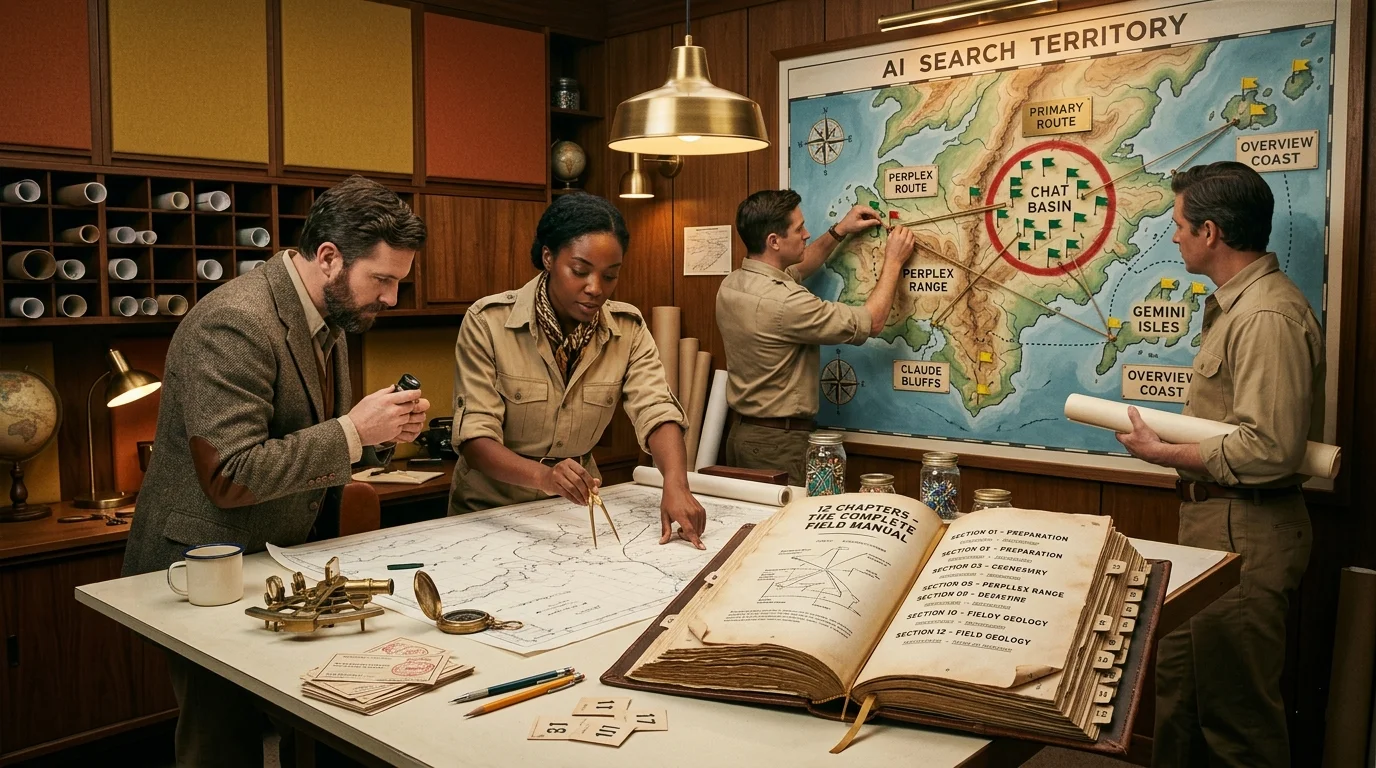
Why This Manual Exists
If you run a business in Hawaii, this is the most important shift in how customers find you since Google launched. People used to ask Google a question and click ten blue links. Today they ask ChatGPT, Perplexity, Claude, Gemini, or Google AI Overviews — and they get a single answer that names a handful of businesses. In Google’s AI Mode, a June 2026 study of local searches found a median of five businesses per answer. In the 649 searches where both AI Mode and the map results returned businesses, only 48% of the businesses in each top three were the same, and 28.5% of top-3 map businesses didn’t appear in AI Mode, though the study doesn’t say whether a business named only in an answer’s text counted (Local SEO Data, which ran the study on the AI Mode API it sells). If you are not one of those names, you are invisible to the people who were going to spend money with you.
This manual is our complete working playbook for getting Hawaii businesses cited by AI search engines. It is built on three things that are ours: the Reef Method, the four-layer framework we use to engineer visibility; the Hawaii AI Search Visibility Index, the open, citable dataset we publish that measures which Hawaii businesses AI engines actually recommend; and the agency casework we have done with clients across hospitality, real estate, restaurants, and home services. It is current as of the May 2026 Google core update and the February 2026 Perplexity publisher guidelines — both of which materially changed how citations are awarded.
Read it section by section, or skip to the one you need. The companion AI Search Playbook is the scannable reference; this is the long-form theory and proof.
Looking for the proof first? The Hawaii AI Search Visibility Index is the open dataset that backs the Hawaii-specific findings in this manual. The benchmark (May 2026) names which 15 hotels and 12 restaurants Hawaii buyers are actually being shown by AI assistants — and which mid-tier categories are invisible.
Part I — The New Search Reality
01. Why AI Search Changes Everything for Hawaii Businesses
Google’s May 2026 reporting confirmed what every operator already felt: AI Overviews now appear on roughly 48% of queries. Roughly 60% of Google searches end without a click. Gartner has forecast that 25% of organic search traffic will route through AI chatbots and virtual assistants by the end of the year. The traffic is not disappearing — it is being mediated by a single AI-generated answer that gets to choose which businesses to name.
For a mainland brand with a national audience, this is a slow squeeze. For a Hawaii business, it is faster than that. Buyers asking AI assistants for “best Waikiki resort”, “Maui wedding photographer”, “Oahu plumber near me”, or “Kailua coffee shops” rarely see a results list anymore. They see a paragraph that names a handful of businesses by brand. And — this is the part that surprises every Hawaii operator we audit — the businesses being named are not always the businesses we expected.
When Nekko Digital ran the Hawaii AI Citation Analysis using our published benchmark, we documented five repeatable visibility patterns that affect every Hawaii vertical:
- Boutique hotels under 50 rooms are systematically underrepresented. Major flagships dominate. Halekulani, Four Seasons Resort Maui, Aulani, The Royal Hawaiian, and Hilton Hawaiian Village absorb the recommendation share — even when the user query implies “boutique” or “small luxury”.
- Mid-tier restaurants are invisible. Iconic destinations (Mama’s Fish House, Helena’s Hawaiian Food, Roy’s, Merriman’s) get named. Mid-tier neighborhood restaurants — the ones doing the volume — are almost never surfaced.
- Niche tour operators concentrate visibility on three or four names per category.
- Wedding vendor datasets in AI memory are thin. Three or four planners and venues per island.
- Neighborhood-level granularity is broken. AI assistants over-index to Honolulu, Waikiki, Lahaina, and Kailua-Kona; smaller markets disappear.
This is not a temporary blip. It is the consequence of how AI engines select sources. Becoming a “default” recommendation is something you earn early or fight uphill for later. That is why this matters now.
02. Generative vs Answer Engines: The Two Visibility Modes
Most “AI search” advice you read online conflates two different things. We separate them deliberately, because they reward different content shapes and need different optimization moves.
Generative engines (ChatGPT, Perplexity, Claude, Gemini, AI Overviews) synthesize an answer from multiple retrieved sources and name a few of them inline. The optimization goal is citation share — being one of the named sources. The discipline is Generative Engine Optimization (GEO).
Answer engines (Google featured snippets, People Also Ask boxes, voice search, AI Overviews when they extract a single passage) lift a specific 40–60-word passage from a single page and present it as the direct answer. The optimization goal is owning that extracted block. The discipline is Answer Engine Optimization (AEO).
AI Overviews sits in both modes. Sometimes it synthesizes; sometimes it extracts. Practically, that means hotels and restaurants — high-comparison verticals — fight on the GEO side; trade businesses with clear procedural questions (“how do I fix X”, “what does Y cost”) fight on the AEO side; everyone in between needs both.
Here is the working comparison we hand to clients on day one. It is the version that lives on our AI Search Optimization strategy hub.
//.measurement_readout · seo · aeo · geo
| Signal | SEO | AEO | GEO |
|---|---|---|---|
| //.goal | Rank in organic results | Be the featured answer | Be cited by AI engines |
| //.key_signal | Backlinks + relevance | Content structure + conciseness | Entity authority + extractability |
| //.measurement | Rankings · organic traffic | Featured snippet wins | Citation frequency · share of model |
| //.platforms | Google · Bing | Featured Snippets · Voice | ChatGPT · Perplexity · Gemini · Claude · AI Overviews |
For a Hawaii business, the practical heuristic we use:
- Hospitality (hotels, resorts, vacation rentals): GEO-primary, AEO-secondary. Buyers ask AI assistants to compare and recommend. Hotels need to be cited by name across multiple engines.
- Restaurants: GEO-primary. The single most common Hawaii buyer query pattern we measured is “best [cuisine type] in [town]” — pure recommendation.
- Real estate (agents and brokerages): Both. Agent recommendation queries are GEO; “what is leasehold vs. fee simple in Hawaii” is AEO.
- Home services and trades: AEO-primary. The dominant query pattern is procedural (“how much does it cost to…”, “do I need a permit for…”). Featured-snippet ownership compounds into citation share over time.
The same content rarely serves both. AEO rewards short, definitive, schema-marked answers. GEO rewards comprehensive, entity-rich, multi-modal authority. We design separately for each, then cross-link.
Part II — How AI Engines Decide Who to Cite
03. The Retrieval Pipeline: From Query to Citation
The single most useful thing you can know about modern AI search is that every answer you see is the output of a four-stage pipeline — and each stage filters who survives. Optimization is upstream work: you do not win at the citation stage if your content was filtered out at the retrieval stage.
EACH STAGE FILTERS · OPTIMIZATION IS UPSTREAM WORK
Stage 1 — Query Expansion (Fan-Out). One user question expands into many sub-queries before any retrieval happens. Google AI Mode does this. Perplexity does this. ChatGPT Search does this. The technical name is “query fan-out”, and it is the single most important concept in modern AI search. A query like “best Maui hotels with kids” silently expands into a dozen variants — “family-friendly Maui resorts”, “Maui hotels with kids’ clubs”, “Wailea kid-friendly properties”, “Aulani vs Grand Wailea for families”, and so on. Your content has to cover the family of related intents, not just the headline query.
Stage 2 — Retrieval. Each sub-query runs against an index. The index is different per engine. ChatGPT Search retrieves primarily from Bing’s index supplemented by OpenAI’s own OAI-SearchBot. Perplexity runs its own crawler against a curated index. Claude’s Research feature pulls from Brave Search. Google AI Overviews uses Google’s main index. Per query, each engine typically retrieves 5–10 candidate documents. Some of those are pure semantic vector matches (embedding similarity); some are still old-fashioned lexical (BM25); production systems do “hybrid search” — both, fused.
Stage 3 — Re-ranking and Fusion. The retrieved candidates are re-scored by a heavier model. Common patterns: Reciprocal Rank Fusion to merge multiple retrieval lists, HyDE (hypothetical document embeddings) to bridge query-document semantic gaps, and contextual re-rankers that weigh authority, freshness, and recency. This is where Perplexity’s documented behavior diverges from ChatGPT’s: SE Ranking’s analysis of 216,524 Perplexity citations found freshness alone accounts for 44.2% of selection weight, and structured data added an estimated +23% to citation probability under Perplexity’s February 2026 publisher guidelines. Google’s March 2026 core update amplified E-E-A-T — Experience, Expertise, Authoritativeness, Trustworthiness — as the dominant weighting factor.
Stage 4 — Citation Selection. Of the re-ranked sources, the synthesis model names 2–4 of them inline in the answer. ChatGPT typically cites 2–4 sources and favors well-known domains. Perplexity casts a wider net — 5–8 citations, often including specialized niche sources. Claude is the most niche-friendly: external analysis found 56% of cited URLs sit under a /blog/ path, 47% are listicle-style URLs, 24% contain a year token, and only 7% point to mainstream news.
The practical implication is uncomfortable for traditional SEO: the URL structure, the publish date in the URL, and the format of the page (listicle vs. essay vs. PDF) materially affect whether a given engine cites you. We bake that into our content production checklist because it is not optional anymore.
04. The Entity Authority Stack: What Makes AI Engines Trust You (GEO)
For generative engines, citation share is a function of entity authority. The engine does not cite a page; it cites an entity (a business, person, product, dataset) that a page documents. If the engine cannot resolve your business as an entity — cannot bind your name to a confident set of attributes (where you are, what you sell, who runs you, what other sources say about you) — it will not cite you, no matter how good your content is.
We model GEO authority as a four-layer stack. Each layer compounds on the one below it.
Layer 01 — Topical Authority. You publish enough demonstrably-original work on a defined topic that the engines recognize you as a domain authority. This is the substrate everything else sits on. A Waikiki resort talking only about its own amenities does not have topical authority on “Waikiki” — it has product copy. The resort that publishes a deep neighborhood guide to Waikiki dining, a multi-part series on Oahu’s weather patterns by month, and an honest comparison of the three Waikiki resort districts is the one engines start treating as authoritative.
Layer 02 — Entity Binding. You make it computationally easy for the engine to identify the entity behind the content. Named authors with Person schema, sameAs links to LinkedIn and other recognized profiles, Knowledge Graph presence, consistent NAP (Name-Address-Phone) across the web. The February 1, 2026 Google Search Central documentation update added a new Authors section — the clearest signal yet that named, persistent authorship is a direct quality factor, not just a UX convention.
Layer 03 — Structured Data. You explicitly declare entities and relationships in JSON-LD that engines can ingest without parsing prose. Article schema with mentions and isBasedOn (we extended our schema generator specifically for this manual). Organization schema for the business. LocalBusiness for the location. FAQPage for the Q&As. Dataset for any open data you publish (which is one of the reasons we publish the Hawaii AI Search Visibility Index as open Dataset-typed data).
Layer 04 — Corroborating Mentions. The engine cross-references the entity across other sources. Press coverage, local directory listings, partner pages, podcast appearances, social profiles, association memberships. For Hawaii businesses, this is where local advantage compounds: a hotel that gets named in the Honolulu Advertiser, the Hawaii Magazine, and the local hotel association directory has corroboration that a mainland equivalent does not.
The visibility gap we documented in the benchmark — boutique hotels invisible, mid-tier restaurants invisible — is not a content problem. The boutique hotels we audited have plenty of content. The gap is in layers 02 and 04: entity binding and corroborating mentions. They are not declared as entities in structured data, and they are not referenced often enough by other sources. AI engines treat them as unknowns.
The fastest GEO diagnostic we run: type your business name into ChatGPT, Perplexity, Claude, and Google AI Overviews. Ask “what do you know about [business name]?” If any engine returns “I don’t have information about that” — your entity binding (Layer 02) is the gap. Then ask “best [your category] in [your town]” — if you are not named, your topical authority (Layer 01) or corroborating mentions (Layer 04) is the gap. The free Self-Audit walks the full 41-point version.
05. The Answer Extractability Stack: What Makes Engines Quote You (AEO)
For answer engines, the citation is the extracted passage itself. Google grabs a 40–60-word block, formats it, and renders it as the direct answer. For voice search, that block is what gets spoken aloud. Position Zero ownership is decided not by your overall authority but by how well a single passage on your page answers a single question.
We model the AEO extraction stack with four layers as well, but the stack is structural — about the shape of the writing on the page.
Layer 01 — Question Framing. Headings on the page are written as the questions users actually ask. Not “Maintenance Schedules” but “How often should I service my AC in Hawaii’s humidity?” Extraction engines look for the answer-to-headline pattern. If your H2 reads like a topic, you lose to the page whose H2 reads like the question.
Layer 02 — Definition-First Sentence. The first sentence under the heading carries the answer. Inverted pyramid. Noun, verb, payload. “Servicing your central AC twice per year is recommended in Hawaii’s climate — once before the dry summer high-heat months and once after the wet winter.” Then you can expand. This sentence is what gets lifted. Research on GEO retrieval pipelines is consistent: definition-first sentence structure correlates with measurably higher impression scores.
Layer 03 — The Answer Chunk. 40–60 words. Self-contained. Scannable. Not “as we discussed in the previous section, the answer depends on…” — that breaks extraction, because the previous section is not in the engine’s window. Each chunk has to stand alone.
Layer 04 — Schema Markup. FAQPage schema around the Q&As, HowTo schema for procedural content, Article schema for the parent post. FAQ schema no longer produces a rich result in Google, but it still tells Google exactly which passage answers which question, so we treat it as standard for AEO. Across multiple independent 2026 analyses, FAQ and HowTo schema are top-five predictive features for citation eligibility. Implement them as JSON-LD; we use the article-schema generator we ship with the site.
For Hawaii trade businesses — plumbers, electricians, AC technicians, roofers, landscapers — the AEO opportunity is straightforward and largely unworked. Voice search is projected to be more than half of all searches by year-end 2026. When a homeowner standing in their hallway asks Siri “how much does it cost to replace a 3-ton AC unit in Honolulu”, the answer that gets spoken is the answer that was structured for extraction. Trade businesses that publish 12–20 structured procedural articles in 90 days do the work that competes for featured snippet ownership.
Part III — The Reef Method: Nekko’s Framework
This is the part where most “AI search guides” turn into a list of tactics. We do not work that way. We work the Reef Method — a four-layer model of how visibility is engineered. Every artifact we publish, every audit we ship, every case study we run binds to one of the four layers. The same model is what we use internally to plan client engagements.
Powered by The Reef Method.
Explore The Reef MethodPrimary layer: Citations · GEO, AEO, Local Pack, and AI-engine citation tracking — what makes the reef visible to ChatGPT, Google AI Overviews, and Perplexity.
The next four sections take the four layers one at a time. The two real client engagements we feature — Lanier Pristine, a residential cleaning company in Gainesville, Georgia, and North Shore Tacos, a restaurant in Hau‘ula and a food truck at Sharks Cove on Oahu’s North Shore — each touched more than one layer. Lanier Pristine’s case study files the work under Coral first, with Substrate and Citations supporting; North Shore Tacos’ files it under Citations first, with Substrate and Coral supporting. Each appears below in one of the layers its work touched: Lanier Pristine under Substrate, North Shore Tacos under Coral.
06. Substrate Layer: The Technical Foundation
The Substrate Layer is the part of the reef that is below the water — invisible to the visitor, load-bearing for everything above. In digital terms: site architecture, schema markup, Core Web Vitals, internal linking, indexability, canonical URLs, robots policy. None of this is glamorous, and none of it is optional. AI engines and traditional crawlers alike walk away from a site they cannot reliably parse. One increasingly common substrate deliverable is a machine-readable site manifest — our full walkthrough of llms.txt shows the production file we generate at build time.
The most common Substrate diagnosis we run for incoming clients: the site looks fine to a human, but the schema is missing, the internal linking is shallow, and the technical foundation is silently disqualifying the brand from AI retrieval. The work is unglamorous. It also moves the numbers.
The Lanier Pristine engagement moved the business from rank #13 to rank #2 in the local pack over 90 days, with visibility climbing from 18% to 73% and inbound Google Business Profile calls climbing from 41/month to 168/month.
The Substrate mechanics we work through, in roughly the order we take them:
LocalBusinessschema with full address, geo-coordinates, opening hours, service area, andsameAsto verified profiles. This is the single highest-leverage Substrate move for a service business.Serviceschema per service offering, with explicitserviceTypeandareaServedarrays. Trade and service businesses dramatically under-declare what they do in structured form. Every individual service should be its own entity.Articleschema on every published guide, with named author +Personschema for the author. Substrate is where author entities get bound to organization entities to topic.FAQPageschema on the FAQ sections of category pages. This is where Substrate touches AEO: the markup labels every question-answer pair so Google understands it (FAQ schema no longer produces a rich result).- Internal linking topology rewritten as a hub-and-spoke pillar architecture, with one pillar page per service category and 6–12 supporting articles linking up to it. This is half-Substrate, half-Coral; we treat it as the bridge.
- Canonical URL declaration and
noindexdiscipline for thin / duplicate / facet pages so the engines do not waste their crawl budget on noise. - Core Web Vitals brought to green across LCP, CLS, and INP.
Substrate work is the work that compounds. It is the work that no single article makes glamorous. It is the work that decides whether the next layer’s content has any chance of being seen.
07. Coral Layer: Topical Authority
If Substrate is the foundation below the waterline, Coral is the visible structure built on top of it: pillar pages, supporting clusters, named authorship, demonstrated expertise. Coral is where “you publish content” turns into “engines recognize you as a domain authority.”
The Coral Layer is where the new E-E-A-T amplification from Google’s March 2026 core update is most visible. Google quality rater guidelines now specifically reward content that demonstrates first-hand experience: “I did this, here is what happened” beats “10 best practices for X.” The Authors section Google added to Search Central in February 2026 is not a documentation update — it is a public signal that named, persistent, credentialed authors are now a direct quality consideration.
Sessions moved from 1,400/month to 12,800/month. Map pack rank from #5.5 to #1.5. DoorDash click-through from 18 to 108 per month. The work was a core-and-outer topical map, menu and location pages rewritten in entity–attribute–value form, and schema binding the two locations to one parent organization.
What this looks like in practice — the North Shore Tacos topical map, as its case study lists it:
Five core pages carried the direct intent (menu, location, online order): /hauula-restaurant/, /sharks-cove-food-truck/, /restaurant-menu/, /food-truck-menu/ and /catering/. Around them sat topic pages built for wider visitor intent; the case study’s topical-map step lists six of the 14 that were added: “Where to eat after surfing Banzai Pipeline”, “What ‘sashimi-grade, never frozen’ actually means”, “Best post-snorkel meal at Sharks Cove”, “Hau‘ula vs. Haleiwa: choosing your North Shore taco stop”, “Baja-Hawaiian fusion: how the two styles meet on the plate” and “Ordering at the Sharks Cove food truck: a first-timer’s guide”. Every topic page links back to a core page.
What makes this Coral and not just “good content” is the structural intentionality: the core and topic pages declare a topic claim. The links back to the core pages declare relationships. The schema declares the entity graph. AI engines can ingest all of this without parsing prose.
The same playbook works for every Hawaii vertical. A Maui wedding planner’s topic pages might start with “Wedding Planning in Maui: A Local Vendor’s Field Guide.” A Honolulu personal injury law firm’s might start with “How Hawaii Personal Injury Cases Actually Work.” The architecture is the same; the topic claim changes. Read our content strategy guide for the production cadence.
08. Citations Layer: AI + Search Visibility
The Citations Layer is the layer this manual is mostly about. Substrate and Coral are the prerequisites; Citations is the surface on which the work pays off. GEO and AEO both live here. Local pack visibility lives here. Featured snippet ownership lives here. And the engine that measures all of it for Hawaii businesses is the Reef Citation Index.
The Citations Layer is also where the visibility patterns documented in the benchmark reveal themselves. To recap, across the 50-query, 5-vertical single-engine baseline:
- The same 15 hotels appear in roughly 80% of hospitality recommendations.
- The same 12 restaurants appear in roughly 75% of restaurant recommendations.
- Mid-tier businesses in both categories appear at single-digit frequencies if at all.
- Real estate query coverage clusters around three or four named brokerages per island.
- Home services queries skew heavily AEO (procedural questions); the few brands cited are the ones with the deepest FAQ + HowTo schema coverage.
The reason the same names dominate is not because they are the best businesses. It is because they have the strongest Citations Layer footprint: entity binding (Layer 02 of the GEO stack), corroborating mentions across press and directories (Layer 04 of the GEO stack), and structured data coverage that makes them computationally easy to recommend. The boutique properties and mid-tier restaurants that visitors actually love are absent because the engines cannot resolve them as entities with confidence.
CITATION IS DOWNSTREAM OF ENTITY RESOLUTION · OPTIMIZE UPSTREAM
This is why we treat the Citations Layer not as a content tactic but as the surface where Layer 01 and Layer 02 manifest. Publishing one more blog post does not move citation share. Binding the entity, declaring the relationships, and earning the corroborating mentions does.
The platform specifics:
- For ChatGPT, indexed coverage in Bing is the prerequisite. The OAI-SearchBot crawler supplements but does not replace it. Confirm in Bing Webmaster Tools that your priority pages are indexed; if not, fix the Substrate.
- For Perplexity, freshness is a 44.2% factor. A static pillar page that has not been updated in 18 months will lose to a competitor’s quarterly refresh, even if the static page is better written.
- For Claude, the listicle /
vs./ “best of” URL structure is over-represented. We do not write listicles for their own sake, but the benchmark’s Claude data is unambiguous: structured comparison content gets cited disproportionately. - For Google AI Overviews, E-E-A-T is now the dominant weighting. Named author with credentials. First-hand experience in the writing. Original data points.
09. Ecosystem Layer: Compounding Authority
The Ecosystem Layer is everything that happens outside your own site. Brand mentions in press. Social presence. Industry association memberships. Speaking engagements. Podcast appearances. Local community involvement. Reputation across third-party review platforms. Partnerships with adjacent businesses.
This is the slowest layer to move. There is no “publish three blog posts and check back in 30 days” version of Ecosystem work. We plan Ecosystem work over months, not weeks. And it is also the highest ceiling — a business with a strong Ecosystem footprint becomes durably hard to displace, because the engines see corroborating signals everywhere they look.
For Hawaii businesses specifically, the Ecosystem advantage compounds in ways that are hard to replicate from the mainland:
- Local press coverage. A piece in the Honolulu Civil Beat, Pacific Business News, or Hawaii Magazine is read as the kind of corroborating mention AI engines look for.
- Industry association membership. Hawaii Visitors and Convention Bureau membership, the Hawaii Hotel Industry Foundation, Hawaii Restaurant Association, Honolulu Board of REALTORS. Directory listings from these associations carry weight because the engines treat them as authority-vetted sources.
- Chamber of Commerce listings. Old-fashioned, still working. The chamber directories crawl well, are persistent, and feed the corroboration layer.
- Local podcast and event presence. Speaking at HTDC, ThriveHI, Pacific Edge events, Hawaii podcast circuit. The mention graph that builds up over a year of these appearances reads to AI engines as evidence that the entity is real, visible, and consequential.
- Honest reviews on TripAdvisor, Yelp, Google Business, and Trustpilot. Volume matters less than consistency. Five-star reviews from real customers, accumulated over time, paired with the business owner actually responding to reviews, is read as trust.
The Ecosystem work is not glamorous and it is not a one-quarter project. We typically structure it as a continuous low-burn workstream that runs in parallel with the more visible Substrate / Coral / Citations work.
Part IV — Measurement, Reality Check, Action
10. How the Reef Citation Index Measures Visibility
The Reef Citation Index is the open Hawaii-specific measurement instrument that backs the visibility claims in this manual. It is the proof of methodology. Anything we say about Hawaii AI search visibility, we can show you in the Index data.
The Index methodology is a four-stage transparent pipeline. There is no proprietary algorithm. No weighting. No black box. Just three things: a published query universe, recorded engine responses, and verified-entity tallying.
CC BY 4.0 · REPRODUCIBLE BY ANYONE
Stage 1 starts with the published query universe — 50 standardized recommendation prompts representative of how Hawaii buyers actually ask AI assistants for help. The full text of every prompt is published with the dataset so anyone can reproduce. Stage 2 runs the queries against each AI engine and archives the full response text. Stage 3 cross-references every cited business against verified registries — Hawaii’s Department of Commerce and Consumer Affairs (DCCA), TripAdvisor verified properties, the Honolulu Board of REALTORS, and Department of Health licensure records — so we are counting real, identifiable entities and not hallucinations. Stage 4 tallies citations per business per engine per vertical per query.
The benchmark was published in May 2026. The license is Creative Commons BY 4.0 — the dataset is reusable with attribution. The reproducibility check is published in full on the Reef Citation Index hub.
We built the Index because the existing commercial citation trackers measure top-1000 national brands at a US-average level. None of them publish a per-Hawaii-vertical breakdown. We needed one to run our work; we publish it openly because the open methodology is itself a citation signal — AI engines treat reproducible datasets with named creators and explicit licensing as higher-trust sources than commercial estimates.
11. The Hawaii Picture: What the Benchmark Revealed
This section is the Index’s findings in plain English. The named entities are the entities the AI engines are actually citing — pulled directly from the published benchmark dataset. The patterns are the patterns we documented across the 50-query universe.
Hospitality. Five hotels dominate the recommendations across most AI engines: Halekulani (Waikiki, luxury anchor), Four Seasons Resort Maui at Wailea (Maui flagship), Aulani, A Disney Resort & Spa (Ko Olina, family), The Royal Hawaiian, A Luxury Collection Resort (Waikiki heritage), and Hilton Hawaiian Village Waikiki Beach Resort (Waikiki volume). Below this tier we also document consistent mentions of: Grand Wailea Maui, Andaz Maui at Wailea, Montage Kapalua Bay, Ko’a Kea Hotel & Resort (Poipu), Mauna Kea Beach Hotel (Big Island), The Kahala Hotel & Resort (Honolulu), Outrigger Reef Waikiki Beach Resort, Sheraton Princess Kaiulani, Hyatt Regency Waikiki, and The Ritz-Carlton Maui, Kapalua. Boutique properties under 50 rooms are largely absent — the gap we already named.
Restaurants. Twelve restaurants are persistently named across the benchmark’s restaurant queries: Mama’s Fish House (Paia, Maui), Helena’s Hawaiian Food (Kalihi, Oahu), Roy’s (multiple locations), Merriman’s (multiple), Alan Wong’s Honolulu (when still applicable in archival data), The Pig and The Lady (Chinatown), Side Street Inn (Honolulu), Liliha Bakery (Liliha), Ono Seafood (Kapahulu), Marukame Udon (Waikiki), Leonard’s Bakery (Kapahulu), and Highway Inn (Kakaako, Waipahu). Mid-tier neighborhood places with strong local loyalty are almost never surfaced. The pattern holds across cuisines.
Real estate. AI engines tend to name three or four brokerages per island, with Locations and Hawaii Life appearing most consistently across queries about Oahu and the Neighbor Islands respectively. Coverage thins past the top three in any given market. Individual agent recommendations are extremely rare — the engines default to brokerage-level recommendations and decline to name individuals when uncertain.
Home services. This vertical is the AEO-dominant one. Featured snippet ownership for procedural questions (“how much to replace AC Honolulu”, “do I need a permit for X in Hawaii”) drives most citation share. The brands cited are the ones with the deepest FAQ + HowTo schema coverage, not necessarily the largest operators. We have seen single-truck specialists outrank multi-truck firms on AEO surfaces.
The businesses being recommended by AI engines are not always the best businesses. They are the businesses whose entity is computationally easy to resolve, whose corroborating mentions are densely connected, and whose structured data declares unambiguously who they are.
A simple visualization of the benchmark’s hospitality citation share — how often each of the top five flagship hotels was named across the 50 hospitality queries:
//.citation_share
The benchmark takeaway for any Hawaii operator below the top tier: your competitive set is not the eleven other boutique hotels in your district. Your competitive set is the five flagships the engine has already decided are the default recommendation. Becoming a default recommendation alongside them is the work. It is GEO Layer-by-Layer work — Substrate, Coral, Citations, Ecosystem — done over 6–12 months. Read the field-study analysis of how the patterns manifest in Hawaii Real-Estate AI Visibility for the parallel vertical example.
12. What to Do Monday Morning: The Action Plan
The 12-section theory is the whole picture. This is the 4-week sprint we ship clients into when they want to start moving the needle now.
30-DAY SPRINT · CONTINUE OVER 6–12 MONTHS
Week 1 — Audit the Substrate. Run the free 41-point Self-Audit. Walk every category page, every pillar page, every priority service page, and check schema, structured data coverage, internal linking depth, Core Web Vitals, named author binding, and Organization / LocalBusiness schema. Fix the gaps before publishing anything new. Substrate work compounds; new content on broken Substrate does not.
Week 2 — Build One Pillar. Pick the single most important topic claim you want to own. Write the pillar piece. 2,000–3,500 words. Named author with Person schema. Honest first-hand voice. Real Hawaii specifics, not generic copy. Internal-link to it from your existing service pages and homepage. Declare Article schema with mentions for any named entities you reference. This is the Coral anchor everything will hang off.
Week 3 — Ship the AEO Content. Identify the 8–12 most common procedural questions in your category — the ones a customer might ask voice search. Write each as its own short page or as an FAQ block on a category page. Definition-first sentence. 40–60-word answer chunk. FAQPage or HowTo schema so Google understands each answer — neither produces a rich result anymore. These are the assets that compete for featured snippets and AI Overview citations.
Week 4 — Monitor Citations. Use your own copy of the Reef Citation Index query universe — pick the 10 queries most relevant to your category — and run them against ChatGPT, Perplexity, Claude, Gemini, and Google AI Overviews. Record who gets cited. If you are not yet named, note who is and audit their Substrate / Coral / Citations footprint. Most of the time the gap is identifiable in 30 minutes of inspection: they have schema you do not, named authorship you do not, or corroborating mentions you do not.
After the 4-week sprint, the work continues as a sustained quarterly rhythm: one new pillar per quarter, monthly cluster pieces, ongoing Substrate hygiene, and quarterly citation monitoring against the Index. We plan that rhythm over 6–12 months, not one sprint. The momentum starts in Week 4.
This manual is the playbook we use for client work. If you want a partner to run it for your Hawaii business — Substrate audit, Coral content production, Citations monitoring, Ecosystem outreach — that is what Nekko Digital does. Schedule a discovery call or read the case studies for Lanier Pristine and North Shore Tacos to see the work end-to-end.
Frequently Asked Questions
What is the difference between GEO and AEO?
GEO (Generative Engine Optimization) is the discipline of getting your business cited by name in AI-generated answers from engines like ChatGPT, Perplexity, Claude, Gemini, and Google AI Overviews. AEO (Answer Engine Optimization) is the discipline of owning the specific extracted passage that appears as a featured snippet, voice search answer, or single-source AI Overview. GEO rewards comprehensive entity-rich authority; AEO rewards short, definition-first, schema-marked answers. Most engagements need both.
How is AI search optimization work phased?
Substrate-layer work (schema, technical foundation, entity binding) comes first, usually in the first 30–90 days. Coral-layer work (topical maps and supporting content) builds on the Substrate in the months that follow, and we re-measure citation share each quarter. Citations-layer work continues across 12–18 months. Ecosystem-layer work is the slowest, and we plan it over 18–24 months. For documented results, see our case studies: Lanier Pristine moved from #13 to #2 in the local pack in 90 days, and North Shore Tacos showed 814% organic growth in 6 months.
Do I need to do SEO and GEO and AEO separately?
No. Traditional SEO (backlinks + relevance + technical hygiene) is the foundation both GEO and AEO build on. A site with strong SEO has a head-start on GEO and AEO. The disciplines diverge in their content and structured data emphasis: SEO targets organic rankings, GEO targets citation share in AI answers, AEO targets featured snippet and voice search ownership. We run them as integrated workstreams, not parallel ones.
What is the Reef Method?
The Reef Method is Nekko Digital’s four-layer framework for engineering AI search and traditional search visibility: Substrate (technical foundation), Coral (topical authority and content), Citations (GEO + AEO + Local Pack), and Ecosystem (compounding off-site authority). Each layer reinforces the others. Every blog post, case study, and service we ship binds to a primary Reef Method layer. Read the full methodology at /the-reef-method/.
Is the Hawaii AI Search Visibility Index free to use?
Yes. The dataset is published under Creative Commons BY 4.0 license at /resources/hawaii-ai-search-visibility-index/. The 50-query universe, the engine versions tested, the validation registries used, and the citation tallies per business are all open. The benchmark was published May 2026 under Creative Commons BY 4.0.
Why are boutique Hawaii hotels invisible in AI search?
Per the Hawaii AI Search Visibility Index benchmark, the largest gap is entity binding (Layer 02 of the GEO authority stack) and corroborating mentions (Layer 04). Major flagship hotels have decades of press coverage, association memberships, and structured-data-rich profiles that AI engines can resolve with high confidence. Boutique properties under 50 rooms often have rich on-site content but lack the off-site corroboration AI engines need to surface them as recommendations. The fix is a 6–12 month buildout of Layer 02 and Layer 04 signals.
Can AI search optimization help a Hawaii business that does not have a national audience?
Yes — and the local-only Hawaii context is often an advantage. AI engines look for corroborating signals across local registries (DCCA, BOR, local press, chamber listings) that are harder for out-of-state competitors to replicate. A Honolulu plumber with deep local schema, named authorship, and Hawaii-specific FAQ content can compete with national franchises on voice search and local AI Overview citations.
How do I measure if GEO is working?
Use the four metrics that have replaced traditional rankings for AI search: Share of Model (how often your brand appears in AI responses for your category prompts), Citation Frequency (raw count of citations across engines), Generative Position (your average rank when included), and Query Coverage (presence across the buyer-intent prompt set). The Hawaii AI Search Visibility Index is the open instrument we use for Hawaii businesses; commercial trackers exist for national brands.
Use our companion resources: AI Search Playbook (platform reference & 30-day plan) · AI Search Self-Audit (41-point self-assessment) · Hawaii AI Search Visibility Index (open benchmark dataset) · The Reef Method (full four-layer methodology) · Digital Marketing Glossary (120+ terms defined).
Ready to engineer your AI visibility? Contact us to discuss how our AI Search Optimization services do the work that helps your Hawaii business compete to be a default recommendation across ChatGPT, Perplexity, Claude, Gemini, and Google AI Overviews.
Rodrigo Diniz
Digital Marketing Specialist & Founder
Digital Marketing Specialist & Founder at Nekko Digital with 15+ years in SEO, web design and AI search optimization.