
AEO vs SEO: What's the Difference?
SEO aims for rankings; AEO competes to be the answer. Learn how Answer Engine Optimization differs from traditional SEO — and why you need both in 2026.

By Rodrigo Diniz Published
Digital Marketing Specialist & Founder
Looking for the production service rather than the explainer? This article compares the disciplines. When you’re ready to act, see our Answer Engine Optimization and Organic SEO services — and the broader AI search optimization practice that connects them.
Same Goal, Different Finish Line
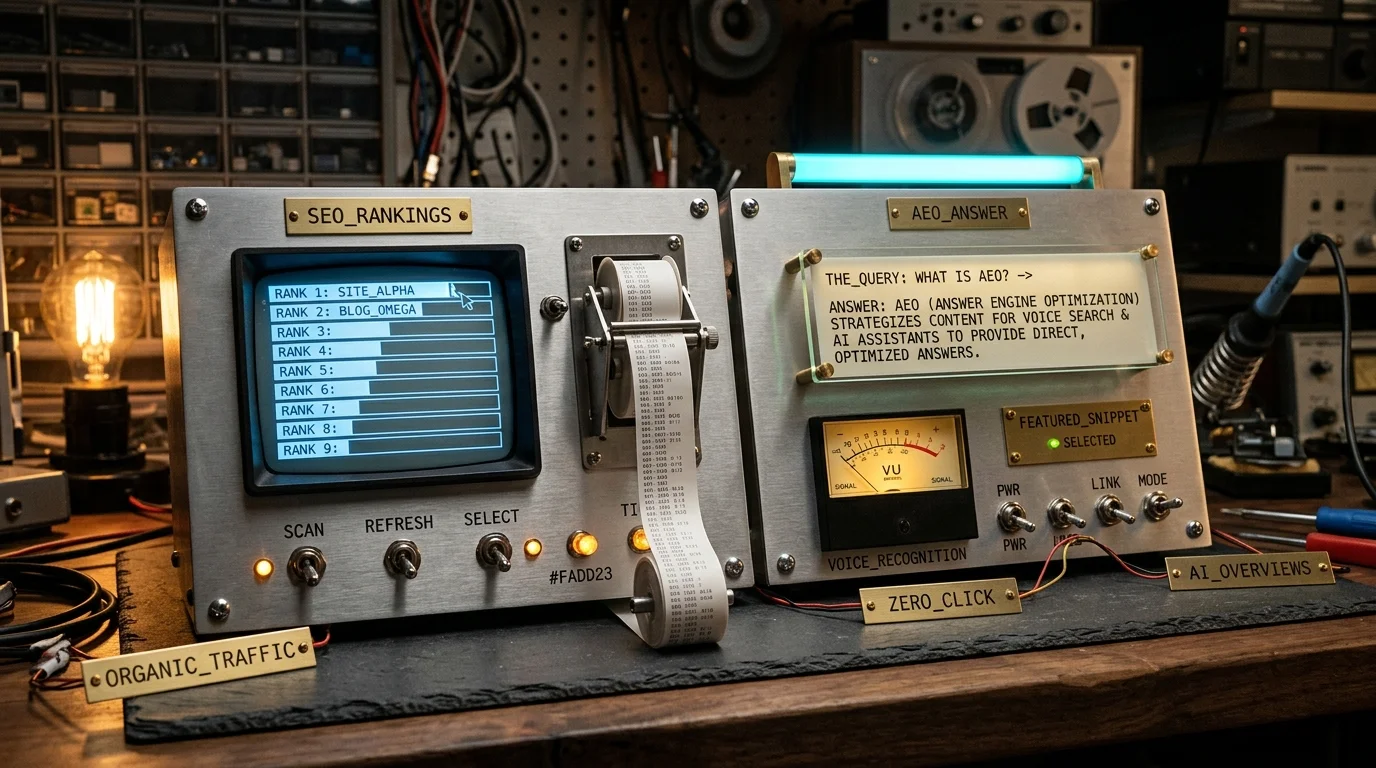
Traditional SEO and Answer Engine Optimization both want one thing: for the right customer to find you. But they define “found” differently. SEO wants your page to rank in the list of results so the user clicks through. AEO wants your content to become the answer the user reads without clicking at all.
That gap matters more every year. A large and growing share of searches now end without a click to any website — the user gets what they need from a snippet, a voice response, or an AI Overview right on the results page. If your whole strategy assumes a click, you’re optimizing for a moment that increasingly doesn’t happen. (Unfamiliar with the terms here? See our digital marketing glossary.)
What SEO Does
Search Engine Optimization is the long-standing practice of earning higher placement in the organic results so people click to your site. Its core levers are familiar:
- Technical SEO — fast, crawlable, mobile-friendly pages (see our technical SEO checklist).
- On-page SEO — titles, headings, and content matched to search intent.
- Off-page SEO — authoritative backlinks and citations that signal credibility.
SEO’s success metric is the click: rankings, traffic, and the visits that follow. It remains the foundation — you generally can’t be the answer if you can’t be found at all.
What AEO Does
AEO optimizes for the answer surfaces that sit above the blue links:
- Featured snippets — the “position zero” box.
- People Also Ask — expanding question accordions.
- Voice responses — what assistants read aloud.
- AI Overviews — the sourced sentences Google’s generative summary pulls from your page.
Its success metric isn’t a ranking position — it’s whether your content is the one extracted and shown. Winning that means writing answer-first (lead with the direct answer, then elaborate), structuring content as clean question-and-answer passages, and marking it up with structured data like FAQPage, which no longer produces a rich result but helps Google understand your questions and answers.
AEO vs SEO: Side by Side
| Dimension | SEO (Search Engine Optimization) | AEO (Answer Engine Optimization) |
|---|---|---|
| Goal | Rank your page in the results list | Become the extracted answer |
| User action | Clicks through to your site | Often gets the answer with zero clicks |
| Success metric | Rankings, organic traffic | Snippet / answer-box ownership |
| Content shape | Full pages matched to intent | Atomic, question-led passages |
| Key signals | Backlinks, content depth, technical health | Concise answers + structured data |
| Where it shows | The organic blue-link results | Snippets, PAA, voice, AI Overviews |
They’re Layers, Not Rivals
AEO doesn’t replace SEO — it sits on top of it. Google still has to crawl, understand, and trust your page before it will lift an answer out of it, and that trust is built with classic SEO fundamentals. The practical workflow is to keep the SEO foundation strong (technical health, topical depth, credible links) and then add AEO formatting to the specific questions you want to own outright.
A Honolulu example: ranking on page one for “Honolulu personal injury lawyer” is SEO. Getting your concise, well-structured answer to “how long do I have to file a claim in Hawaii?” pulled into the answer box is AEO. The first earns the visit; the second earns the trust before the visit even happens.
Which Should You Focus On?
You don’t really choose — you sequence. If your site’s fundamentals are shaky, fix SEO first; answer boxes are built on pages engines already trust. Once the foundation is solid, layer AEO onto your highest-intent questions to capture the zero-click surfaces your competitors are ignoring.
And if your customers are increasingly asking conversational engines like ChatGPT and Perplexity for recommendations, that’s a third discipline — Generative Engine Optimization. See GEO vs AEO for how those two relate.
The Bottom Line
SEO gets you found; AEO positions you to be the answer. In 2026 the winners run both as one connected system rather than treating AEO as an afterthought. That’s how we structure engagements under our AI search optimization practice — and we publish the proof: the Reef Citation Index tracks how often Hawaii businesses are actually cited by Anthropic Claude in our 2026 benchmark, and runs on other engines on request. Reach out if you’d like the foundation and the answer layer built together.
Rodrigo Diniz
Digital Marketing Specialist & Founder
Digital Marketing Specialist & Founder at Nekko Digital with 15+ years in SEO, web design and AI search optimization.