
Made-in-Hawaii E-Commerce Strategy
Made-in-Hawaii e-commerce: HRS 486-119 compliance, product schema for origin claims, brand positioning, and the visitor-to-mainland reorder loop.

By Rodrigo Diniz Published
Digital Marketing Specialist & Founder
Why “Made in Hawaii” Is a Real Brand Asset
Few state-of-origin labels carry the brand premium that “Made in Hawaii” does. Mainland consumers pay sustained premiums for Kona coffee, Hawaiian sea salt, Maui-grown chocolate, Hawaiian Host macadamia products, locally crafted ukuleles, and authentically produced aloha shirts. The premium is real, durable, and competitively valuable — but the right to use the “Made in Hawaii” claim is statutorily defined under HRS §486-119, and the enforcement risk for misuse is substantial. This post is the strategic framework for Hawaii brands that qualify under the rule, want to make their qualification visible, and want to compound the brand premium into long-term mainland-customer revenue. We cover the broader cluster in our Hawaii e-commerce SEO pillar guide; this is the Made-in-Hawaii-specific deep dive.
The HRS §486-119 Framework
Hawaii Revised Statutes §486-119 defines what a product can be sold or marketed as “Made in Hawaii,” “Produced in Hawaii,” or “Processed in Hawaii.” The rule has three structural elements:
- The product must be manufactured, assembled, fabricated, or produced within Hawaii.
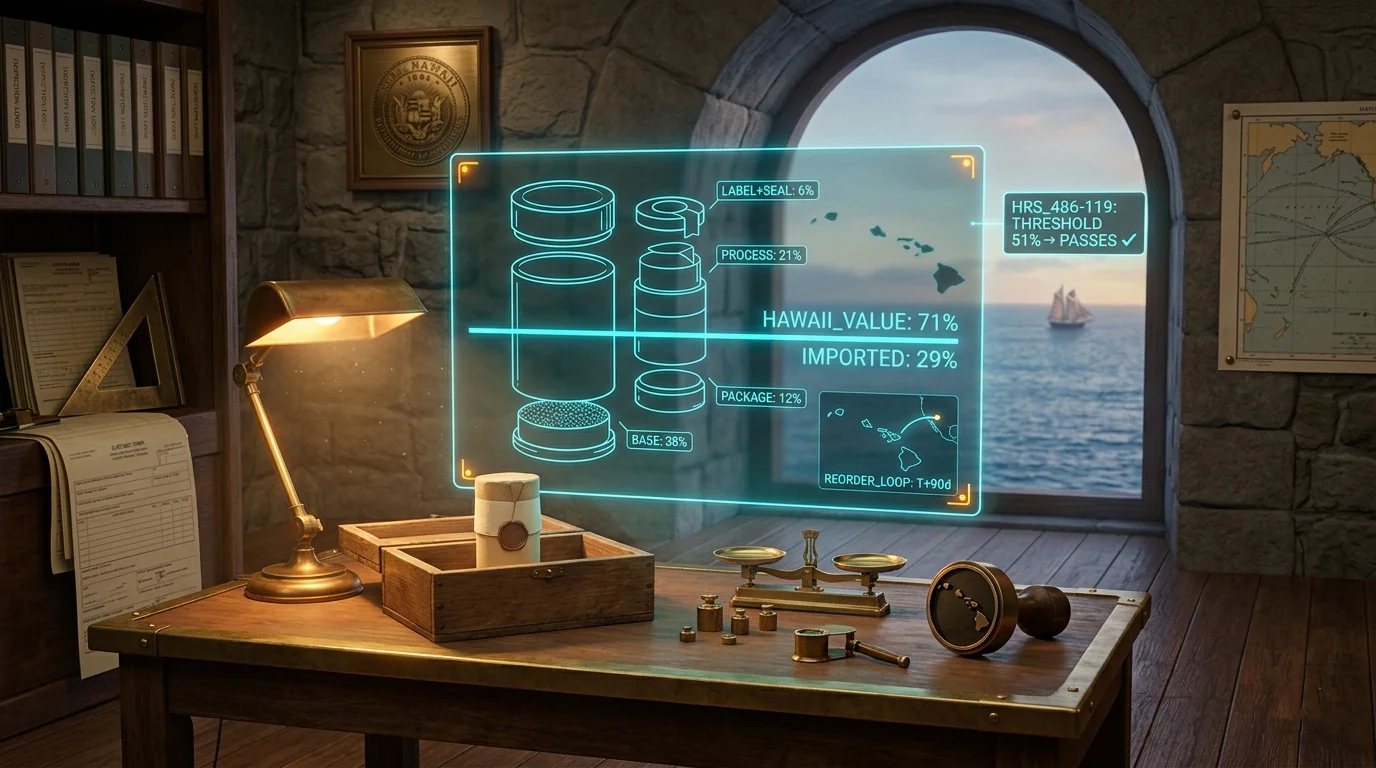
- At least 51% of the product’s wholesale value must be added through that in-Hawaii manufacturing, assembly, fabrication, or production.
- The rule applies to advertising and marketing — not just to physical labels. Websites, product pages, ad creative, packaging, and any commercial communication using “Made in Hawaii” or origin-implying language are all in scope.
The Hawaii Department of Agriculture & Biosecurity publishes guidance on the rule at dab.hawaii.gov. Perishable consumer commodities (coffee, honey, chocolate, salt, food products) are treated the same as durable goods for the 51% test.
What counts as “value added in Hawaii”
The wholesale-value calculation is product-specific and benefits from compliance counsel review. The general framework: raw material cost from outside Hawaii does not count toward the 51%; labor, processing, manufacturing, packaging, and other value-adding activities performed in Hawaii do count. A coffee that is grown, harvested, roasted, and packaged in Kona almost certainly qualifies; a coffee that is grown elsewhere, shipped to Hawaii, roasted in Hawaii, and re-shipped almost certainly does not qualify; the middle cases (Hawaii-grown beans blended with mainland beans, varying ratios) require careful calculation.
The “Hawaiian-Style” Trap
The temptation that costs Hawaii brands money — and creates real legal exposure — is using Hawaii-implying language without qualifying under HRS §486-119. “Hawaiian-style,” “Aloha [product],” island imagery, palm tree silhouettes on packaging, Hawaiian-language words used commercially, and product names referencing Hawaii places (Maui Onion, Kona, Big Island) have all been litigated when the underlying product did not meet the 51% rule.
The line is clearer than many brands realize:
- Qualifying products can use “Made in Hawaii,” “Produced in Hawaii,” “Processed in Hawaii,” origin-explicit packaging, and origin-explicit marketing freely.
- Non-qualifying products can use Hawaiian-style aesthetic (tropical visuals, island imagery in moderation) but cannot claim or imply origin. The product name needs to avoid Hawaii-place-name implications when the underlying product is not actually from that place.
Class-action exposure has been documented when brands cross this line — for both small artisan operations and larger consumer-goods companies. The mitigation is straightforward: meet the rule and use the label, or do not meet the rule and avoid origin-implying language.
Brand Positioning for Qualifying Products
For brands that qualify under HRS §486-119, the strategic question becomes: how do you make the qualification visible to buyers who care about it, while building durable brand equity that compounds over years?
Visible qualification on product pages
The qualifying signals to surface above the fold on every product page:
- A “Made in Hawaii” badge in the product header or near the price.
- A 1–2 sentence explainer of what that means for the specific product — “Our coffee beans are grown and roasted in Kona,” “Our aloha shirts are cut and sewn in Honolulu from imported fabric (the fabric is imported but the construction adds the majority value),” “Our sea salt is harvested by hand from Hanapepe.”
- Photography or video that shows the in-Hawaii production process. Visual proof is materially more persuasive than text claims.
Origin storytelling at the brand level
Brands that compound the Hawaii premium pair the per-product signals with brand-level origin storytelling — a substantive “Our Story” or “Our Process” page covering where the brand is located, who works there, how products are made, and why the Hawaii origin matters to the product. This is the content AI engines cite when surfacing “best Hawaii [product category]” queries, and it’s the content mainland buyers read when deciding between a brand and its mainland imitator.
Consistency between in-store and online
Visitors who buy a Hawaii brand’s product in-store during their trip notice when the brand’s online presence misaligns with the in-store impression. Different product names, different packaging photography, different brand voice, missing origin signals — all break the visitor-to-mainland-customer loop our pillar guide covers in depth. Brands that maintain consistent presentation across channels compound the in-Hawaii purchase into a recurring mainland reorder over years.
Product Schema for Hawaii-Origin Claims
The structured-data implementation that supports the brand positioning above is product schema enrichment with Hawaii-origin signals. The Schema.org Product type accepts several properties that signal origin to AI engines and Google’s Knowledge Graph:
{
  "@type": "Product",
  "name": "Single-Origin Kona Coffee",
  "brand": {
    "@type": "Brand",
    "name": "[Brand Name]"
  },
  "manufacturer": {
    "@type": "Organization",
    "name": "[Brand Name]",
    "address": {
      "@type": "PostalAddress",
      "addressLocality": "Captain Cook",
      "addressRegion": "HI",
      "addressCountry": "US"
    }
  },
  "countryOfOrigin": {
    "@type": "Country",
    "name": "US"
  }
}
The Hawaii signal flows through the manufacturer.address PostalAddress, with addressRegion: "HI" carrying the state-level origin. AI engines bind this to the brand and product entity at the structured-data layer, citing the brand more reliably for “Hawaii [category]” queries than brands without the address signal. For the full Product schema configuration, see Schema.org’s Product reference — and for the broader AI search context, our AI Search Optimization framework covers the signal-building work end to end.
For Shopify implementation specifics, see our Shopify SEO for Hawaii businesses post — the Liquid theme enrichment is straightforward but requires deliberate customization.
The Visitor-to-Mainland Reorder Loop
The structural growth opportunity for most Made-in-Hawaii brands is the visitor reorder loop. A visitor buys in Maui, returns to Portland, runs out three months later, searches the brand name, and either finds the online store fluidly or doesn’t. The brands that build for this loop compound mainland-customer revenue year after year; the brands that ignore it lose to mainland imitators who occupy the digital surface.
The mechanics:
- In-store email capture. Loyalty signup, gift-with-purchase enrollment, post-purchase warranty registration. Any compliant capture mechanism that gets a returning visitor’s email into a sequenced program.
- A welcome sequence that anchors the in-Hawaii memory. The first email after a visitor returns home should reference their trip, the brand’s location, and the product they likely bought — anchoring the emotional association with the place.
- Seasonal reorder reminders. “It’s been six months — time to restock?” emails for high-frequency-reorder products (coffee, supplements, personal care). The cadence matches the product’s natural reorder cycle.
- Annual return-visit invitation. “Coming back to Hawaii this year?” emails one year after the original purchase. Brands that operate retail in Hawaii capture in-store-visit revenue from this audience; brands that operate online-only capture the warmth-of-relationship signal that drives repeat online purchase.
- Gift-occasion seeding. Mother’s Day, Father’s Day, Christmas, hostess-gift season. Visitors who bought for themselves often buy for someone else after returning home — and the right email at the right time captures that purchase.
What Made-in-Hawaii E-Commerce Brands Should Ship First
If a qualifying Hawaii brand could only execute three things from this framework in the next quarter, the order would be:
- HRS §486-119 compliance audit. Document the 51% calculation for each SKU. Confirm marketing copy aligns with what the underlying product qualifies for. The mitigation work is finite; the legal-exposure reduction is durable.
- Product schema enrichment with Hawaii-origin signals. Manufacturer Organization with Hawaii address, countryOfOrigin, brand entity. AI engines and Google bind these signals to the brand at the structured-data layer — and the binding compounds over months.
- Visitor email capture and welcome sequence. The single highest-leverage growth mechanic for most Hawaii brands. Compliant in-store capture + a sequenced post-visit program closes the loop that mainland imitators cannot replicate.
The Made-in-Hawaii positioning is one of the rare brand assets where compliance work is also growth work — the same activities that satisfy the statute also compound the citation surface that AI engines use to recommend the brand. For the broader engagement framework — including category-level content authority, GET tax configuration, USPS shipping setup, and AI search auditing — see our Hawaii e-commerce SEO guide and the e-commerce SEO service page. For Shopify-specific implementation, see Shopify SEO for Hawaii businesses.
Rodrigo Diniz
Digital Marketing Specialist & Founder
Digital Marketing Specialist & Founder at Nekko Digital with 15+ years in SEO, web design and AI search optimization.